This month we’ll be looking at how some Gaelic language forms, such as diminutive endings, were simply carried over naturally to English or Scots words in local speech, particularly in people’s names.
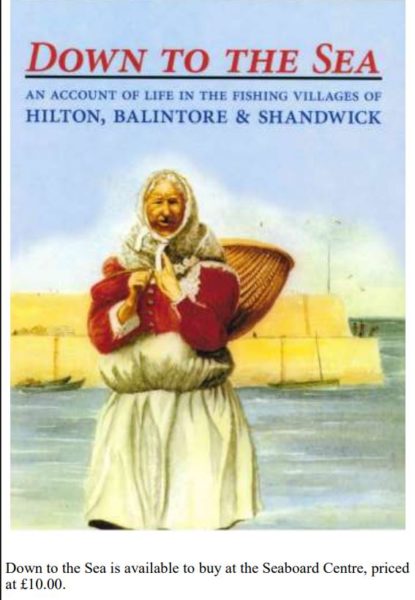
If you have the newest edition of Down to the Sea (2018), you’ll have seen the wonderful long list of by-names at the back. It’s much more than a list – it’s a mini social history of each of the Villages, so well worth a read or a re-read! Among them are many of my relatives and family friends, or neighbours of my grannie’s, or unknown figures who featured in local stories, and it brought back a lot of childhood memories to read that list when it was first published. So many thanks to all who contributed – an invaluable resource of local knowledge that otherwise would have disappeared.
But it’s also a great resource for those interested in language, like myself, as it’s full of examples of the often mutual influence of Gaelic and Scots.
In Gaelic, if you add -ag or –an to a word, it conveys a smaller version of the original (with things), or a more familiar or affectionate version (especially with names). A lochan is just a small loch, a boyan is a small boy, a young lad. You may know them in the Gaelic words sliseag (sleeshack) and tuircan (tourcan), still common locally. When applied to names, David might become Dave-an (=Davie), for example, or Anne or Anna might become Annag (=Annie). Classically, –an was for masculine words and –ag for feminine, but this was not closely adhered to locally, with men’s names sometimes getting the -ag treatment too. –ag is pronounced -ack, so that’s what usually got written down.
Examples of the -ag/ack ending in my own family history include Jimmack Oliver, my uncle, and Davack Ross, my grandfather. Other male names I remember were Buiyack, Johnack, Danack and Willack, and lots of female ones: Bellack, Dollack , Nanack, Curstack (Kirstie), Kateack. The -an ending was definitely used more for males – Jockan, Willican, Toman.
It’s worth pointing out that the pronunciation of these names was usually, and often still is, very Gaelic – the first part is stressed and generally longer, and there’s a wee gap before the –an or –ack.
The lack of stress on that ending also led to it being eroded – sometimes the -ag or -an would become just -a. Examples I recall: Kate-a, Doll-a, Wull-a, Dan-a, John-a, Kenn-a. Very Gaelic intonation!
Some female names ending in -an are actually Ann/Anne as the second half of a double name (another very Gaelic thing). The most famous example in the Villages is probably Bellan (Isabelle Ann /Bell Ann / Bel Ann etc) MacAngus, mother of Dolly, or Dollack. When this is spelled together as one word, saying it aloud helps to establish what kind of –an it is – the diminutive –an ending (unstressed), or the name Ann (usually stressed equally with the first part). I also had an Auntie Christan, the -an part unstressed, but I am not sure if that was a diminutive Christine, or the remains of Christine Ann. There were also Johndans on the Seaboard – whether John + an with an extra D, or John + Dan (double name), I don’t know. Anyone? EDIT: as a relative informs me, just a diminutive of John, no double names. And there were several in the family. And Christan was Christine Ann, but her mother used the pet name Christan after hearing it used elsewhere.
It wasn’t just names that got these -an and -ag endings – sometimes they were added to things as well, e.g. shop-an, skirt-an (Gaelic sgiortan), and cutag or guttag for a gutting knife. But with the English names of things, the Gaelic endings were less common than the Scots -ie, as often already attached to the words when they were brought to the area by Lowlands and Moray farming folk at the time of the agricultural “Improvements”. There is a Gaelic word-ending – aidh, pronounced “ee” (e.g. Ciorstaidh = Kirsty), so it was an easy transition for Gaelic speakers to make. A baggie and a listie for the shoppie, a boatie, a bairnie are the sort of thing that caught on. People also got the –ie ending, sometimes combined with the Gaelic –ag: Nanackie, Willackie.
Occasionally the ending -ach would be used instead, either as a variant on the pronunciation of -ag, or the Gaelic ending -ach used for turning a noun into an adjective, eg. Sasainn/Sasann (England) > Sasannach (English). So we have Sandach (for Sandy), the Alachs, the Morachs etc.
The prevalence of the same first names as well as surnames throughout the Villages led to plenty of by-names to help distinguish them, and often these by-names would get carried down through the generations, their original reference getting lost en route. Names are more varied nowadays, but traditionally in the Villages, and in fact still in the main Gaelic-speaking areas today, it’s always been hard to break the pattern of calling first sons after fathers and daughters after mothers etc. So adding a distinguishing term was not only a good Gaelic tradition but a necessity. Until, of course, the by-name became attached to each generation, so that grandfather, father, son and grandson might all once again have the same name! The William “Chats” Ross family are a good example of this. (I learned from the list that this came from a Charlotte further back in the family who was known as Chattie.)
The by-name might be the person’s job – Thomas Vass the Post, Jimmy the Van, or where the family originally came from – the Woods from Cellardyke got the by-name “the Dyker” or “the Decker”, and there were also Rosses known as Morach / Morrach – probably from the Gaelic for someone from Moray. There was even a Johnny-up-the-hill Ross, who worked on Hilton farm. Other by-names were less clear, such as Buzz, or the Claws, or the Roggles, or Jockan and Ali “the Bolt” Vass, and usually had a story attached. My Latin teacher was Johnnie “Leekie” Ross from Balintore, himself from a Ross family called the Cuppies. These by-names could also be Gaelic words, like my father’s (Sutherland) family, the Alachs, or the “Raws” and “Roos” (possibly from ruadh – red-haired).
But there was one very Gaelic way of distinguishing between multiple William Rosses etc, and that was by saying who their mother or wife was: that’s how we get “Jock Kate” for John Skinner, or “Billy Nanack” Ross, or “Geordie Minnie” Mackay, or a family of Vasses all given “Ethel” as a kind of surname. And of course the “Chats” Rosses, from Charlotte. Women might also get distinguished by their father’s name, such as Bella Danack, or Bella Davack.
Gaelic also has a common method with “aig” (= at) for saying who you belonged to, and this led to things like “Dolly at Bellan”, “Joan at Curly”, and I got called “Davine at Hughie” more than once. (Which I objected to in my teens as I wanted to be myself, not some else’s appendage!)
So keep collecting the by-names and their stories, and maybe they’ll feed into any future editions of Down to the Sea. Our names, their stories, and our rich local language are as much our heritage as the Pictish stones, and the objects we display in our museums. Let’s keep them alive and kicking!
Tadhail air seaboardgàidhlig
Powered by WPeMatico





#/media/File:Broad_Street_station_exterior_geograph-3270123-by-Ben-Brooksbank.jpg)