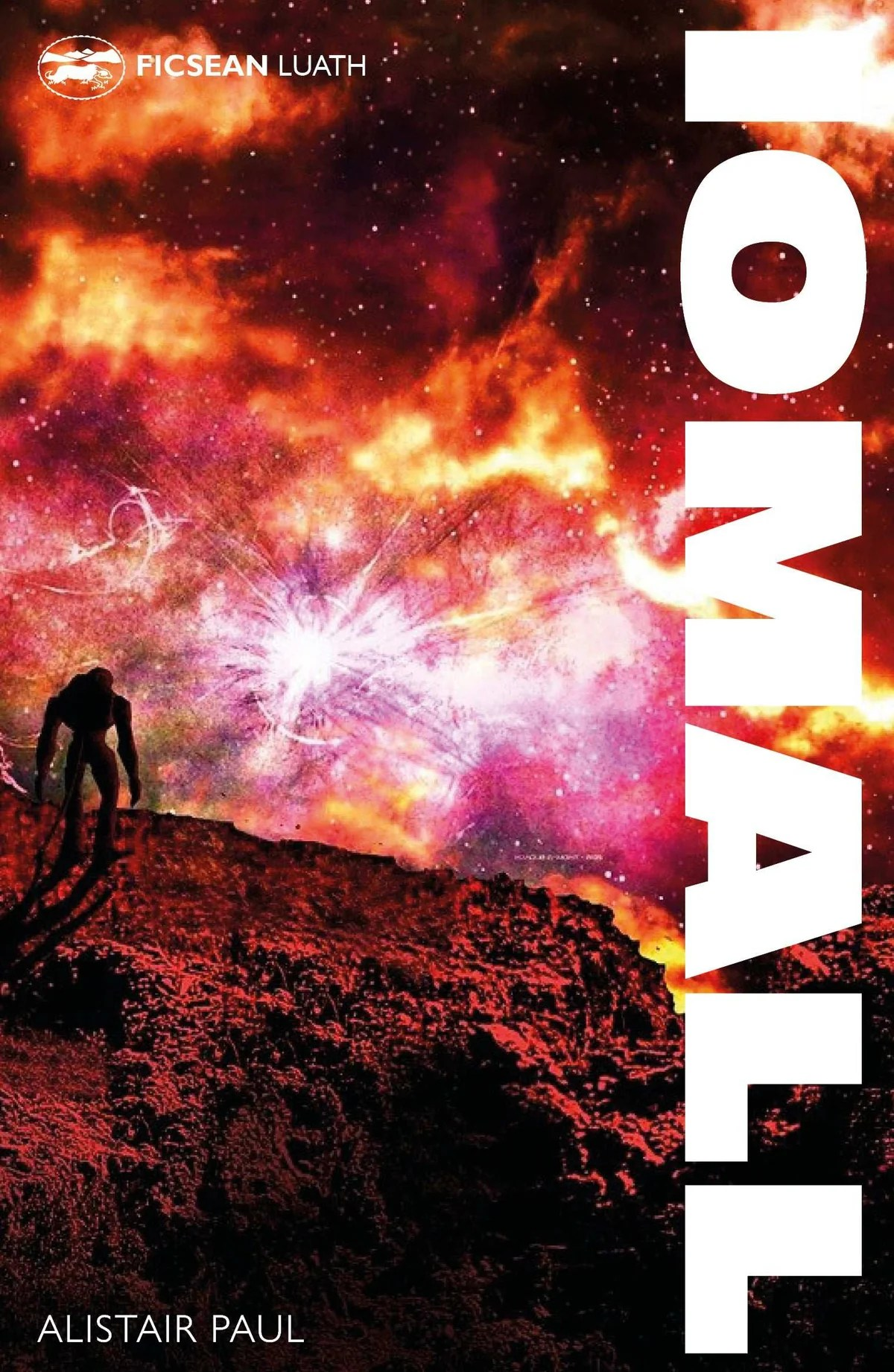
Dh’fhoillsich Nathaniel Harrington lèirmheas smaoineachail air Iomall le Alasdair Paul anns a’ Glasgow Review of Books seachdain sa chaidh a thug e orm beachdachadh bu dòcha gum bu chòir dhomh an leabhar aige a leughadh a-rithist. Thug Alasdair còir cothrom dhomh a leughadh mar dhreach corra bhliadhna air ais mar thaic ri pìos air ficsean-saidheans Gàidhlig a bha mi a’ sgrìobhadh aig an àm. Chòrd e rium gu mòr an uair sin, agus bha mi toilichte nuair a chunnaic mi gun tàinig e a-mach an clò o chionn greis. Rinn Luath Press deagh obair air a dhealbhadh, le còmhdach àlainn. Tha e glè tharraingeach, saoilidh mi. Mar sin, tha mi a’ dol a cheannach leth-bhreac, agus tha mi a’ dèanamh fiughar ri coinneachadh ris na sgeulachdan aige a-rithist. Mholainn an lèirmheas aig Nathaniel Harrington, agus mholainn Iomall, cuideachd. Tha e uamhasach math!
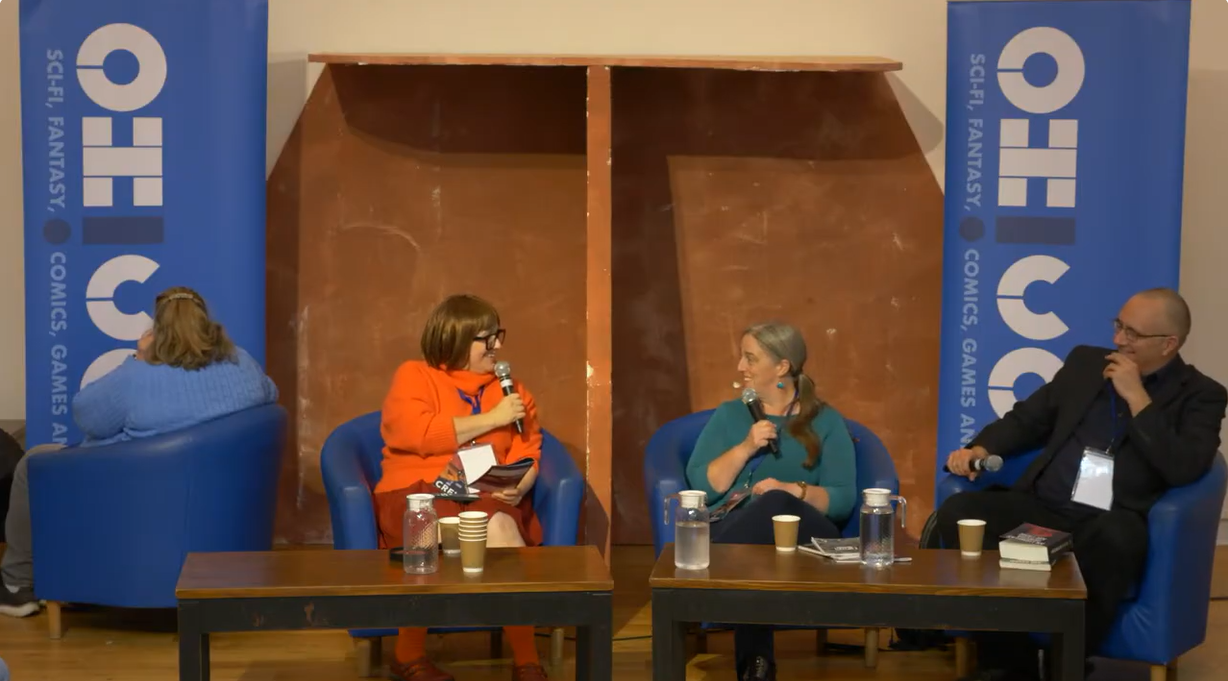
Bha tòrr spòrs agam aig OH!CON am bliadhna ann an Steòrnabhagh. Seo a’ chiad turas a bha mi a-riamh aig a’ cho-labhairt seo, agus bha e sgoinneil. Mholainn gu mòr e. Ceud taing dhan a h-uile duine a thàinig a dh’èisteachd dhuinn!
Ma bhios sibh faisg air Steòrnabhagh air Disathairne an treasamh latha dhen Dàmhair, tha mi a’ dol a bhith a’ bruidhinn anns an t-seisean Ghàidhlig aig OH!CON 2026. Nach tig sibh ann! Cha robh mi a-riamh aig a’ cho-labhairt seo, agus tha mi a’ dèanamh fiughair mhòr rithe. Chan eil mi buileach cinnteach fhathast dè seòrsa cruth a bhios air an t-seisean againn, ach ’s e an tiotal aige:“’S iomadh aon a mheall mi don bhrugh le binneas mo chiùil”: A’ cruthachadh sgeulachdan tuairmeasach Gàidhlig dhan 21mh linn, agus saoilidh mi gu bheil e a’ dol a bhith aibheiseach math!
Tuigse nas fheàrr air cuid de na cothroman is dùbhlain a tha mu choinneimh choimhearsnachdan dùthchail: ’s e sin a fhuair Comataidh nan Cùisean Dùthchail an dèidh dhaibh tadhal air trì pròiseactan ann am baile Loch Àlainn air a’ Ghàidhealtachd aig deireadh an Lùnastail. Rè an cuairtean do Choille Coimhearsnachd na Morbhairne, do dh’Oighreachd Àird … Leugh an corr de Fios naidheachd: BPA bho Chomataidh nan Cùisean Dùthchail a’ tadhal air Loch Àlainn
On Island Voices’ 21st birthday(!), this is the final blogpost from the project before the longstanding academic linkage with UHI is brought to a close, with the retirement of its co-ordinator. Following on from the Heritage and Risk discussion, this post continues the previewing of the project rationale, with a focus this time on the key components of the community project and the basic structure of the university archive that captures it for posterity.
Community Project
The Hebrides-based “Guthan nan Eilean” (Island Voices) online language capture and curation project was born in 2005 out of the European project “POOLS” (Pooling Open Online Learning Systems). Multilingual partners across the continent teamed up to develop user-friendly technical aids for lesser-used languages, and POOLS was duly completed in 2007. Nearly 21 years later, Island Voices lives on still, having massively grown and diversified along the way while maintaining its linkage to UHI, now through the Language Sciences Institute CIALL project. (A detailed 2005-2023 history is available online.)
The Gaelic content spreads across a range of genres, domains and linguistic registers – with a principled focus on the spoken vernacular – including the unscripted real-life speech of ordinary community members, as well as documentary narrative and contemporary poetry from well-known writers and performers, such as Donald S Murray, Martin MacIntyre, and the late great Norman Maclean. The content reflects contemporary life through the unfiltered voices of real community members. Bespoke assistive technologies provide access for learners and non-speakers.
The societal challenges that Gaelic now faces are not unique to it, and its problems cannot be solved by looking only inwards. Island Voices has always balanced its Hebridean focus with an openness to cross-linguistic collaboration. Alongside Scots and Shaetlan examples, Irish and Welsh are important Celtic comparators. South Asian and Caribbean collaborations have also thrown light on potential connections that are still under-explored with other minority diaspora communities in Scotland and across the UK, while the English component is multi-functional.
The more recent Extensions initiative shows how the Island Voices model is being progressively adopted and adapted for other languages. Ifor ap Glyn, National Poet for Wales 2016-22, is the latest to make a significant contribution in this format.
Overall, Island Voices remains at heart a community-based project, and will continue in that role indefinitely, even after the archiving of its first 21 years of output at the University of the Highlands and Islands, an institution whose educational remit covers both Higher and Further Education. Even so, a grounding linkage to academic research has been a key complementary focus throughout its existence, as recorded, for example, in Research/Reports. This UHI archive is one more example of the project’s key bridging function between community and academy.
University Archive
The new archive consists of two main parts:
Mirror digital copies of 500+ videos created by Island Voices and platformed on YouTube.com will now be securely stored within UHI’s own archives and made freely available for public, student, and staff access. This collection is divided up thematically into eleven “series” and can be accessed directly through the archive catalogue.
The entire Island Voices WordPress.com website as it stood on 1st September 2026 has also been copied and archived, consisting of 500+ blogposts and pages. This serves to trace the full history of the project from the very start of its online presence. The blogposts track its development path step by step and offer important contextual detail on the video contents. The pages gather groups of videos together under a range of themes to help navigate the entire collection. As an archived copy of the website, some changes have been made to guard against any uncontrolled digital loss over time. Thus, additional links have been added to the tables of YouTube video contents, providing equivalent links to the corresponding archived copies.
So that’s it, the cut-off date has been reached, and the archive will freeze the collection as it stands on 1st September 2026. By no means does it signify the definitive end of the community project, but it’s a relief to know that the first 21 years’ work is now secured for posterity. For further news of the university archive, followers may wish to keep an eye on the LSI news page.
Meanwhile, although Island Voices posts will probably diminish in frequency and intensity henceforth, they may not come to a complete halt for some time yet… Cùm cluas ri claisneachd!
The Island Voices project offers a model of community-based action in the maintenance of linguistic diversity and heritage in a world in which minoritised languages are under unprecedented threat. The archive stands out through its platforming of the voices of the people in the sharing of their unique cultural heritage.
So says the introduction to the imminently forthcoming Island Voices Multilingual Archive stored at the University of the Highlands and Islands (UHI). On the cusp of Island Voices’ 21st birthday, here’s a potted preview of some of the overall rationale that persuaded The National Lottery Heritage Fund to offer its support, focussing on heritage and risk in the context of global linguistic diversity.
Heritage
The remaining Gaelic communities of the Western Isles are the last inheritors of an unbroken culture and oral tradition that forms an intricate and integral part of Scottish history and identity. It stretches back well over a thousand years, and manages to live on still, despite its now severely minoritised position. Set against this historical backdrop these Hebridean communities also offer a casebook study of contemporary cultural dynamics in which bi- and multi-lingual contacts and contexts present often stark challenges and choices. This societal environment of steadily continuing encroachment upon traditional and conventional domains for the use of Gaelic, in everyday life as much as in more or less formal cultural pursuits such as the composition or performance of poetry and music, is replicated in similar form in many other minority linguistic cultures, whether indigenous or migrant diasporic, both elsewhere in Scotland and the UK, as well as globally.
Humanity has a widely diverse linguistic heritage, evolved to respond to the grounded particularities of different times and places across the world. The Gaelic language encodes a unique worldview as it is experienced by its speakers in their homes and community locales. The Scottish Languages Act gives official recognition to the importance of the language within Scotland, and puts some legal measures in place to support its continuing use, both on a nationwide basis and in relation to special “areas of linguistic significance”.
To some extent, this official response relates to corresponding situations with other languages in similar situations, for example Irish or Welsh. In search of solutions to the problems facing a particular language community, there is room for well-informed exploration of other similarly challenged cultural heritages through coming together in joint enterprises, while retaining a grounded sense of local realities. Over the last twenty years the Island Voices project, based in the Outer Hebrides, has been capturing and curating the natural speech of Gaelic speakers as they voice in their own words their memories, thoughts, and reflections.
The approach taken has been readily transferrable to enable comparison with, and adoption by, other similarly minoritised linguistic communities. This has resulted in a Gaelic-weighted yet profusely multilingual collection of 500+ video recordings featuring the authentic speech of community members as they relate unscripted stories, memories, descriptions and explanations, complemented by song performance and poetry recitation, and introduced by short plain language narrative documentaries. This is the heritage, highly valued by fluent community members, academic researchers, and language learners alike, that this archive seeks to safeguard.
Risk
In an era in which the loss of languages, particularly minoritised “heritage languages”, is proceeding across the globe at an alarmingly accelerated rate, the risk to Gaelic (and other languages within the UK polity) is now well documented, for example through the comprehensive “Gaelic Crisis in the Vernacular Community” book jointly authored by UHI Language Sciences Institute staff with other sociolinguistic researchers. Gaelic has been shown to face the imminent prospect of ceasing to operate as a language of daily use and conversational exchange in a community setting.
The last generation of fluent speakers with lived experience of growing up in a Gaelic-dominant environment, and hence acquiring the language through a normal process of inter-generational transmission at home and in the community, is of advancing age. They have important stories to tell from their own early life experiences, as well as their own reflections on witnessing the dramatic changes in community life as this transformative language shift has occurred before their eyes.
Island Voices has been a local presence for the past two decades in capturing and curating these narratives through the voices of ordinary community members. These are voices which may often struggle to be heard or noticed in national or institutional policy and decision-making fora, yet on which any language maintenance or planning initiative is crucially dependent, as they embody the linguistic competence which such bodies may seek to protect or promote.
Throughout this period, Island Voices has relied on technical and funding support from a wide range of disparate bodies in order to create and sustain its grassroots level approach, capitalising on powerful new digital affordances that help mitigate against documented linguistic risk. With the professional retirement of the project co-ordinator, there is now a requirement to gather the disparate outputs co-created with multiple stakeholders into a secure central storage point with guaranteed long-term longevity, to safeguard the digital artefacts themselves in a duplicated store, and ensure ongoing free public access to the first 21 years of the collection.
In working with the UHI Archive to capture and deposit the Island Voices project, the Language Sciences Institute has ensured this resource and its metadata are appropriately captured, catalogued, and safeguarded – digitally preserved to prevent decay, and promoted with stakeholder communities and the public in order to provide permanent access to the collection for future use and research.
So this must be among the longest of all Island Voices’ blogposts, as it marks an important inflection point! It’s been a blast, but we’re not quite done yet…
As we enter August, our various 21st anniversary summer exhibitions are still running in the Hebrides and in Glasgow – though not in all cases for much longer. So if you want to see them on-site, please pay a visit to Taigh Chearsabhagh (North Uist), Museum nan Eilean (Benbecula), Cnoc Soilleir (South Uist), or the Scottish Poetry Rose Garden in Queen’s Park (Glasgow) sooner rather than later! Of course, they will remain accessible online indefinitely through the bold Island Voices links above.
We are very keen to receive feedback, either written or spoken. The poster above gives both a telephone number and an e-mail address where you can leave your own thoughts and opinions in English or Gaelic. (Or you can just leave a comment on this post if you prefer!) At the risk of repetition, we’re interested in the views of active participants in the project as well as viewers and listeners from near and far. If you want some guidance, here’s the sort of thing we’re interested in:
As always we’re keen to receive reflections, suggestions and further questions about our project – not just to help evaluate what we’ve done so far, but also in the hope of stimulating new ideas for what could come next. And we welcome input from all sources, including previous active participants in the project (What did or didn’t work well? What could we have done differently? What did you learn from the experience? etc) as well as viewers and listeners who’ve sampled the materials online, or attended one or other of the various events and exhibitions over the summer of 2026 (What did or didn’t you like about the contents you tried? What would you like to see more of? Did it prompt any memories you’d like to share? Have you got other suggestions? etc).
We are very keen to receive spoken or written feedback in English or Gaelic by phone or e-mail.
You can leave a voicemail at this number: 01463 279110
The Scottish Poetry Rose Garden in Glasgow’s Queen’s Park is the venue for the open-air Island Voices exhibition, opening on the 12th July, of the Five Writers featured in its Extensions initiative. Each one has their own stand in the garden, with QR codes to take viewers directly to their body of video work, including multi-lingual versions of their introductory documentary, plus samples of their poetry and conversational style in their own particular language. We’re delighted to partner with Friends of Queen’s Park in facilitating this exhibition in such fitting surroundings, and grateful for the support of The National Lottery Heritage Fund in making it possible.
If you can’t visit in person, you can click on the image below to take you to an enlarged version with live links attached to the QR codes for each of the five writers:
As an added bonus, links are also available via the posters below showcasing earlier recordings by our special Rose Garden guest Alan Riach, Professor of Scottish Literature at the University of Glasgow. Alan also added some classic historical perspective to our lively 11th July Saturday night preview of the exhibition in Queen’s Park Parish Church. (Click on the images for the live links.)
As always we’re keen to receive reflections, suggestions and further questions about our project – not just to help evaluate what we’ve done so far, but also in the hope of stimulating new ideas for what could come next. And we welcome input from all sources, including previous active participants in the project (What did or didn’t work well? What could we have done differently? What did you learn from the experience? etc) as well as viewers and listeners who’ve sampled the materials online, or attended one or other of the various events and exhibitions over the summer of 2026 (What did or didn’t you like about the contents you tried? What would you like to see more of? Did it prompt any memories you’d like to share? Have you got other suggestions? etc).
We are very keen to receive spoken or written feedback in English or Gaelic by phone or e-mail.
You can leave a voicemail at this number: 01463 279110
With summer upon us, venues across Uist and Benbecula are now showcasing the 2005-2026 compilation video that brings together into one 7-minute clip representative highlights of the 20+ years of the Island Voices/Guthan nan Eilean project. Alongside the video itself, additional information panels provide background information with QR codes that enable readers to access the original source materials from which the compilation was selected, so opening up the 500+ online videos for immediate viewing.
Here’s the main background panel:
You don’t have to attend in person to find these links. A click on the above graphic will take you to an enlarged image with live links attached to every QR code displayed.
Here are the local Hebridean venues where the collection is currently on display:
We’re keen to receive reflections, suggestions and further questions about our project – not just to help evaluate what we’ve done so far, but also in the hope of stimulating new ideas for what could come next. And we welcome input from all sources, including previous active participants in the project (What did or didn’t work well? What could we have done differently? What did you learn from the experience? etc) as well as viewers and listeners who’ve sampled the materials online, or attended one or other of the various events and exhibitions over the summer of 2026 (What did or didn’t you like about the contents you tried? What would you like to see more of? Did it prompt any memories you’d like to share? Have you got other suggestions? etc).
We are very keen to receive spoken or written feedback in English or Gaelic by phone or e-mail.
You can leave a voicemail at this number: 01463 279110