Bidh an Fhèis Phoileataigs a’ tòiseachadh ann an ùine nach bi fada. Mar phàirt den phrògram, bidh Jim Whannel, neach-foghlaim a tha dìreach air a dhreuchd a leigeil dheth mar Stiùiriche Foghlaim aig Bòrd na Gàidhlig, a’ gabhail pàirt ann am pannal beachdachaidh mun bhuaidh aig Earrann 28. Chuir sinn beagan cheistean air Jim mun … Leugh an corr de 35 bliadhna bho Earrann 28 – agallamh le Jim Whannel
Thèid cuireadh a thoirt do Phàrlamaid na h-Alba nas fhaide air an t-seachdain seo gus Dàibhidh Hamilton ainmeachadh gu A Mhòrachd an Rìgh airson dreuchd Coimiseanair Fiosrachaidh ùr na h-Alba. Beachdaichidh a’ Phàrlamaid air gluasad aontachaidh airson Mgr Hamilton a chur an dreuchd air Diciadain 28 Ògmhios. Tha dùil gun lean Mgr Hamilton Darren Fitzhenry … Leugh an corr de Fios naidheachd: Pàrlamaid gus Coimiseanair Fiosrachaidh ùr na h-Alba ainmeachadh
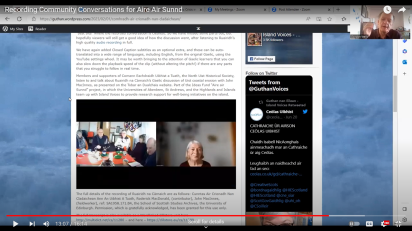
Following on from the North Uist “Wellbeing” survey, Gordon Wells this week reviewed the Island Voices contribution to the Aire air Sunnd project led by Comann Eachdraidh Uibhist a Tuath.
Adopting a slightly different format to Jess Wood’s presentations last week, Gordon speaks to camera on Zoom while screen-sharing key points from the Island Voices Aire air Sunnd webpage. Speaking in Gaelic he reinforces the point that using this language does not exclude non-speakers or early learners, given the multilingual technical resources that are now available online.
His video recaps the various recordings that have been created for the project in the past year or so, including the “Gaelic Crisis” presentation, and the Progress Report, as well as the recording sessions with community members covering storytelling, artefact description, and environmental issues. In so doing, it also shows how the YouTube subtitling and auto-translation functions can be put to effective use, and includes a quick demonstration of the Clilstore platform too, while emphasising the alternative effectiveness of recorded speech in a world where written communication is often taken for granted as the default norm.
Summing up, Gordon stresses the untapped value of various recording collections (in addition to Island Voices’ own), noting in particular how open resources such as Tobar an Dualchais have the potential to bring present and past communities together in a new manner to support North Uist cultural wellbeing, offering innovative ways of forward-looking engagement with the island’s Gaelic heritage so positively valued by all. At the same time, it needs to be recognised that community-wide engagement in such activity is dependent on community-wide comfort with the new digital tools that enable it. This is probably an area of work that needs closer attention.
The results of the Aire Air Sunnd community survey in North Uist are going online. Jess Wood from the University of Aberdeen kicked off on Monday 19th June with an overview, split between two videos on a dedicated CEUT YouTube playlist, both of which are well worth watching to get a sense of the breadth and depth of the project. It’s been an ambitious collaborative exercise, turning out interesting and challenging findings for anyone interested in taking a rooted and holistic approach to community wellbeing across the board.
For those with a particular interest in Gaelic, Jess has devoted quite a bit of time in the first video to analysis of responses on this topic. We’ve picked out some headlines below.
The overall sample of 79 respondents divided themselves up roughly equally between Fluent Speakers, Learners, and Non-speakers of Gaelic.
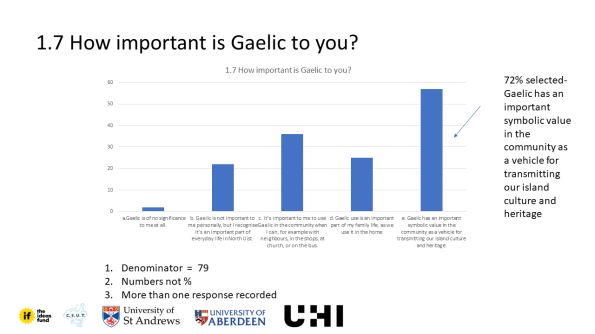
The slide below shows a really strong level of agreement in the group overall with the notion that “Gaelic has an important symbolic value in the community as a vehicle for transmitting our island culture and heritage”.
Another immediately striking statistic is the 90% figure for those expressing concern over the declining trend in use of Gaelic, as shown in this slide:
And what may be particularly interesting about this figure is the way that similar sentiment is shared across all three groups – Fluent Speakers, Learners, and Non-speakers – with even 58% of those who have no Gaelic expressing concern about the decline in its use.
While Jess is duly cautious in her presentation, a topic eliciting a 90% level of concern might well be considered a community wellbeing issue worthy of further investigation…
If these figures pique your interest do take a look at the online presentation to find out more. The project also plans to run another face-to-face event in August at which Gaelic and other questions arising from the survey will be further discussed and developed. You can find full details and keep abreast of other events leading up to it on the CEUT Facebook page.
Here’s Part 1 of Jess’s presentation, in which she provides an update on the findings of Section 1 of the survey (including the questions on Gaelic):
In Part 2, Jess talks about the key findings of Section 2 – Use of the School, and Section 3 – Personal Wellbeing:
And coming soon, keep an eye out for an Island Voices video follow-up from Gordon Wells on “Recording Community Conversations”, to be followed shortly after by more detail on Digital Use and Activities with Alan Miller and Sharon Pisani from St Andrews University.
The beginnings of the Island Voices/Guthan nan Eilean project can be traced back to 2005 and the original European POOLS project in which Sabhal Mòr Ostaig (SMO) played a key co-ordinating role, with Gordon Wells appointed as Project Officer. It’s been a fascinating journey ever since, from the bilingual English and Gaelic recording of the first Craigard documentary video onward, in an ever growing and diversifying collection of “slices of life and work in the 21st Century Hebrides” combined with thoughts and reflections from both community members and interested observers.
“This article provides a comprehensive description of the Island Voices/Guthan nan Eilean language capture and curation project as it stood in Spring 2023. The introduction presents information on its main features and aims, the linguistic rationale focussing on the primacy of speech and the salience of bilingualism, and the Hebridean community context in which the project operates. This is followed by a detailed account of the project contents and chronology, divided into four separate sections or phases: Staff-led Production; Participatory Production; Multilingual Diversification; and Research Alignment. In conclusion, connections to further research and development projects and opportunities are sketched out, and some final reflections question a polarising juxtaposition of local versus global interests, while pointing towards responsibilities alongside the opportunities this kind of work entails.
Describing a primarily oral project through written text presents a challenge. Copious footnotes point to online samples of the materials discussed, and readers are encouraged to engage through screen as well as page in order to extract full benefit. The article is bookended by a preamble and postscript which offer written exemplification from short, transcribed extracts.”
And from the conclusion:
“There may be a lesson here for applied and socio-linguistic professionals. In a meaningfully socially aware mission, the development and display of academic and linguistic prowess should surely show and serve a genuine community connection and purpose. Such, at least, are the principles which the Island Voices project aspires to uphold. The project trajectory, while linguistically guided, thus aims at inclusiveness in content organisation and presentation, remains open to new inputs, and has an undefined end-point still over the horizon.”
Watch this space, a chàirdean! Agus cumaibh cluas ri claisneachd…
Sa bhloga mu dheireadh, dh’aithris mi air an turas agam gu Ceann Loch Chille Chiarain. Am measg rudan eile, chaidh mi air chuairt gu Eilean Dà Bhàrr.
Bho thill mi dhachaigh, tha mi air rudeigin inntinneach ionnsachadh mun eilean – gu bheil stampaichean aige. B’ àbhaist bogsa puist a bhith san eilean agus dh’fhaodadh tu litir no cairt-phuist a chur bhon eilean, ach dh’fheumadh tu stampa Eilean Dà Bhàrr a bharrachd air stampa àbhaisteach. A rèir coltais, sguir an t-seirbheis puist seo sna 1960an, ach lean iad orra a’ cruthachadh stampaichean fada às dèidh sin leis gun robh iad a’ còrdadh ri daoine.
Tha stampaichean mar seo meadhanach cumanta airson eileanan beaga. Tha traidisean fada de bhith a’ dèanamh stampaichean ann an eilean Lundy (no Ynys Wair sa Chuimris) ann an Devon. Ann an Alba, ’s e na h-Eileanan Samraidh as ainmeile airson a bhith a’ dèanamh stampaichean den t-seòrsa seo. Agus tha stampaichean mar seo aig a’ mheanbh-nàisean Sealand far costa Suffolk cuideachd.
Airson stampaichean mar seo, tha iad feumail gu ìre – is urrainn dhut rudeigin a chur bhon àite agus thèid a stampadh bho Ynys Wair no Tanara Mòr etc agus tha e mar chuimhneachan air an àite ged nach eil e cho cudromach ri cudromach cothrom a bhith agad litir a chur nuair a bhios tu air turas latha ann.
Fhuair mi a-mach nuair a bha mi a’ rannsachadh seo gu bheil cuid de dh’àiteachan no eileanan a’ dèanamh nan stampaichean dhaibh fhèin ged nach eil feum sam bith orra air adhbharan postachd. Nam measg Colbhasa agus Ìle. Agus tha e math fhaicinn gu bheil iad dà chànanach (ged a tha a’ Ghàidhlig ceàrr air stampaichean Ìle – tha “an t-Eilean Ìle” aca…..). Bidh cuid a dhaoine gan cruinneachadh agus tha iad nan dòighean math gus an t-àite a shanasachadh ma chuireas tu stampa air litir còmhla ris an stampa àbhaisteach.
Fhuair mi a-mach gu bheil ainm sònraichte air stampaichean mar seo: Stampaichean Cinderella. Tha iad a’ gabhail a-steach an fheadhainn air a bheil feum air choireigin leithid nan Eileanan Samraidh ach cuideachd stampaichean mar an fheadhainn ann an Colbhasa no Ìle aig nach eil ròl postaidh sam bith agus stampaichean sanasachd, leithid iomairtean poilitigeach. Mar eisimpleir, nuair a chaidh stampaichean a chruthachadh leis a’ Phost Rìoghail airson Alba, A’ Chuimrigh agus Èirinn a Tuath a bha rud beag eadar-dhealaichte ri stampaichean Shasainn, cha deach stampaichean Còrnach a chruthachadh agus chur seo dragh air nàiseantaich na Cuirne agus chruthaich iad an stampa seo.
A bharrachd air seo, ge-tà, fhuair mi a-mach gu bheil an leithid de rud ann ri stampaichean rathad-iarainn cuideachd.
San àm a dh’fhalbh, dh’fhaodadh tu litir a phostadh air trèana no stèisean rèile agus bha agad ri stapma a cheannach bhon chompanaidh rèile a bharrachd air stampa àbhaisteach. Saoilidh mi gur e rud a bha seo a thòisich ann an làithean tràtha nan rathaidean-iarainn nuair nach robh siostam a’ phuist buileach cho leasaichte. San latha a th’ ann, tha bogsaichean puist anns na stèiseanan mòra uile, leithid Glaschu Mheadhain agus bidh bogsa puist gu math faisg air cha mhòr gach stèisean co-dhiù.
Lean seo air adhart gu làithean BR ach mu dheireadh thall, sguir iad. Ach chùm cuid de na rathaidean-iarainn glèidhcte orra le bhith gan dèanamh. San latha an-diugh tha an Talyllyn agus Rathad-iarainn Ffestiniog sa Chuimrigh, Rathad-iarainn Nene Valley ann an Sasainn gan dèanamh fhatathast. Tha iad rim faighinn ann an Eilean Mhanainn cuideachd agus gu dearbha, chuir mi litir dhachaigh le stampa bho mhullach Snaefell ann an Eilean Mhanainn uair.
Rud a tha inntinneach, ’s e gu bheil trèanaichean air tòrr de na stampaichean nach eil aig na rathaidean-iarainn. Mar eisimpleir, rinn Eilean Dà Bhàrr sreath de stampaichean de thrèanaichean – ged a tha an stèisean as fhaisg air san Òban!
Bha ùidh aig m’ athar nach maireann ann an stampaichean agus bhiodh rudan mar seo air còrdadh ris glan! Bhiodh e a’ cruinneachadh stampaichean co-cheangailte ri Esperanto – an cànan eadar-nàiseanta anns an robh e fileanta, agus stamapichean bho dhùthchannan beaga a b’ àbhaist a bhith anns an USSR leithid Latbhia is Lituania agus eileanan beagan leithid Eilean Ascension agus Alderney.
Tha eòlaichean ann an Oilthighean Dhùn Èideann agus Ghlaschu air £225,000 fhaighinn bho Riaghaltas na h-Alba gus siostam fo-thiotalan Gàidhlig a chruthachadh a bhios freagarrach dhan BhBC.
Bheir am maoineachadh cothrom dhan sgioba tòiseachadh air obrachadh a dh’ionnsaigh a bhith a’ cruthachadh modail cànain mòr – coltach ri ChatGPT – airson luchd-labhairt na Gàidhlig.
Gheibhear barrachd fhiosrachaidh mun phròiseact an-seo.
In our second community recording for Aire air Sunnd there are two new features. Firstly we’re very grateful to the Tobar an Dualchais project, and of course to the next-of-kin, for making a recording of Ruairidh na Càrnaich available for discussion in the same manner we used for “Còmhradh air Blàr Chàirinis“. This was a suggestion and request that came from the Comann Eachdraidh Uibhist a Tuath Gaelic group themselves, to which Flòraidh Forrest at Tobar an Dualchais responded immediately and most helpfully, going the “extra mile” to additionally commission a transcription of the recording, which has also been a great help in creating a Clilstore unit for the full YouTube clip. It was Ùisdean’s idea to pick this particular clip, in which Ruairidh talks about historical coastal erosion in North Uist, in a recording made in 1958. With climate change now such a “hot topic” it makes particularly interesting listening to hear how it was thought about and discussed in times gone by.
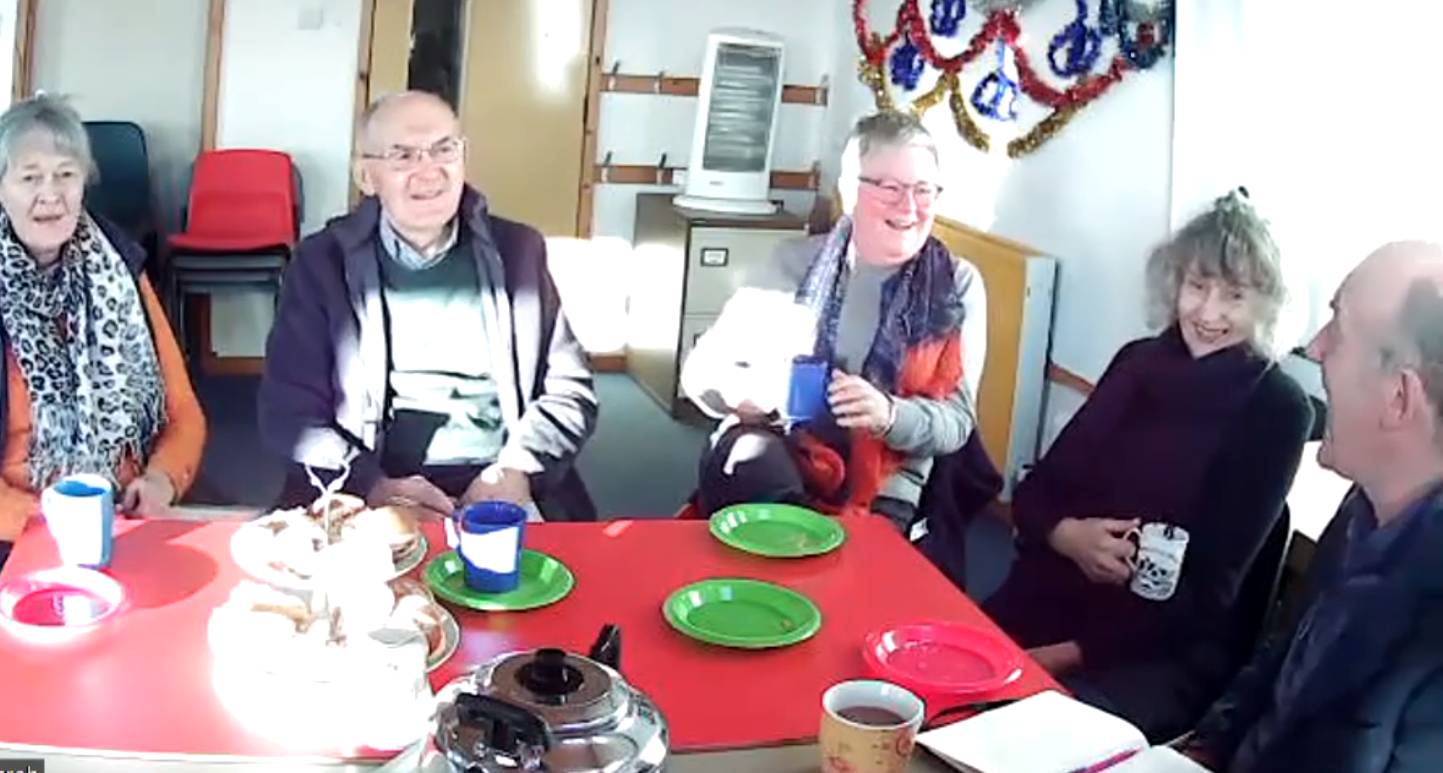
Secondly, we also experimented with a “hybrid” format for the meeting, with most of the participants meeting together in Sgoil Chàirinis, while a couple of others joined in on Zoom. Obviously, it’s easier to hold a conversation with people all in the same room together, though that does pose recording challenges, particularly when folk are quite naturally more likely to all talk at once, and you’re trying to use the ordinary everyday recording equipment we all now have to hand in our phones or laptop computers. So it was interesting to see how that would work with some people also joining in remotely. We’ve done some editing with the final recording to select “best bits” where the recorded conversation is clearest. So we have missed some parts out, but hopefully viewers will still get a good idea of how the discussion went, after listening to Ruairidh’s high quality audio recording in full.
We have again added Closed Caption subtitles as an optional extra, and these can be auto-translated into a wide range of languages, including English, from the original Gaelic, using the YouTube settings wheel. It may be worth bringing to the attention of Gaelic learners that you can also slow down the playback speed of the clip (without altering the pitch!) if there are any parts that you struggle to follow in real time.
Members and supporters of Comann Eachdraidh Uibhist a Tuath, the North Uist Historical Society, listen to and talk about Ruairidh na Càrnaich’s Gaelic discussion of Uist coastal erosion with John MacInnes, as presented on the Tobar an Dualchais website. Part of the Ideas Fund “Aire air Sunnd” project, in which the Universities of Aberdeen, St Andrews, and the Highlands and Islands team up with Island Voices to provide research support for well-being initiatives on the island.
The full details of the recording of Ruairidh na Càrnaich are as follows: Cunntas Air Crionadh Nan Cladaichean Ann An Uibhist A Tuath, Roderick MacDonald, (contributor), John MacInnes, (fieldworker), ref: SA1958.171.B4, the School of Scottish Studies Archives, the University of Edinburgh. Permission, which is gratefully acknowledged, has been granted for this use only.