CEUT Reflections 4

Le Gordon Wells

Here’s the fourth of our series of blogposts by Mary Morrison in which she reflects on the Aire Air Sunnd project led by Comann Eachdraidh Uibhist a Tuath. As with her previous posts, comments are welcome!
sgoil chairinis

Mary writes:

Cafaidh Gàidhlig agus Feasgar Dimàirt. 

‘Even the sheep and cows seemed to know who we were.’

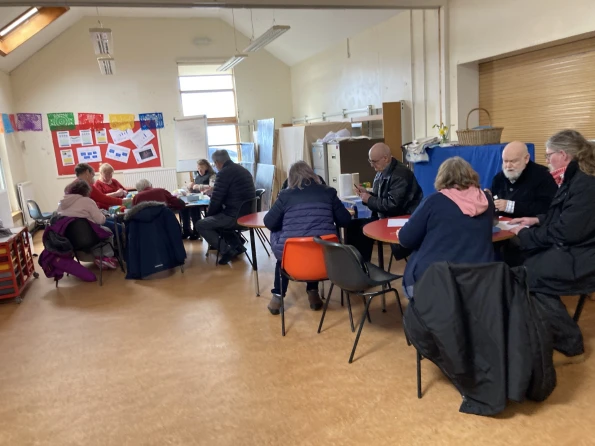
During February and March the wellbeing and Gaelic groups have spent an interesting time sharing our thoughts about the place of North Uist, based on the key findings of the CEUT 2023 Community Survey.  We have tried to explore further the unspoken, deeper meanings lying beneath our concerns, in order to provide more pressing evidence to convince  potential funders of the urgency of our bids for the refurbishment of Sgoil Chàirinis, as a Gaelic, heritage and wellbeing community centre.

The common concern underlying these activities is our attempt to define CEUT’s role in so far as it may contribute to the local communities’ sense of wholeness, robustness and cheerfulness. The project wants to encourage some form of cultural shift, using the aspects of our place that are our greatest assets to fortify the island’s biological, environmental and human wellbeing. The wisdom inherent in vernacular voices and local practices may be best suited to reach the centres of power and exert some influence? 

The ideas developed during Feasgar Dimàirt will also be incorporated into a community mural, (or separate panels of such a wall hanging) to celebrate the unique heritage and resilient Gaelic culture of North Uist – a collaborative visual legacy for the project, and a way of combining a wide range of the communities’ artistic and storytelling talents. We are grateful to our partners here, Caraidean Uibhist and Sgoil Uibhist A Tuath for collaborating so willingly in this placemaking effort.

To begin the process of mural shaping we discussed what made us most happy about living on North Uist. The listening was intent, the group itself seemed at home, offering respect, calmness and space to put complex ideas and feelings into words, at our own pace, often qualifying and refining these.

Our recurring ideas:

  • the magic or spell of the place, the land and its unique, unchanged qualities 

‘Clarity of the light’, ‘changing colours of the water’, ‘layers of colours of the sand the seaweed and the sea as it stretches to infinity’, ‘poetry of creation’, ‘the sound of the sea’, ‘roaring like traffic’, ‘mindfulness’, ‘losing yourself’, ‘birdlife”, ‘walking for ever without a destination’, ‘the capacity of the environment to change so suddenly’, ‘peace and beauty’, ‘a constant surprise’.

  • identity, family and ancestors – especially for our indigenous dwellers 
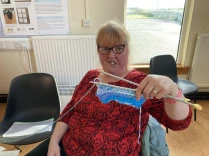
knittingGaelic method of reciting of the male members of a family tree, sloinneadh, all the precious ‘connections to the local community’, heritage of knitting, peats, creel and rope making, weaving, families widening out but often returning, ‘recognising our closeness to other cultures‘, ‘confidence in new life’, growth – babies of all species- keeping the ceilidh culture and the songs going, the ‘friendliness’ of the community.

  • placemaking, local names, wells and the need to map, signpost and mark these 

‘Views that have remained unchanged from what our ancestors saw’, noticing the changes in coastline, species, disappearance of Gaelic, wells, standing stones and their stories, some urgency to preserve.  ‘Getting more sentimental as I grow older’. Mention here of milestones, waymarks trails, mapping the area for future generations and visitors, with the stories attached to them.

  • and for settlers or returners, the profound sense of suddenly belonging, feeling at home and enriched by the place 

‘Last night the tide was very high, I went out and stood, just watching it.

I suddenly  felt so glad to be living.’

‘Glad to be here’

‘Coming from a dry, hot and dusty area, the silence, nothing, the sound of the sea was astonishing.

‘Even the sheep and cows seemed to know who we were’
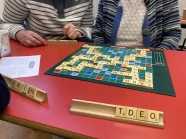
ScrabbleThe Cafaidh Gàidhlig sessions were also held in Sgoil Chàirinis over February and March. Smaller numbers here made these more intimate occasions and provided Gaelic speakers with an opportunity to speak freely in an informal setting. Games and learning activities, including the new Gaelic version of Scrabble and a beginners’ Gaelic lesson were available each morning.

Gaelic speakers were able to engage fully in profound conversations without having to give way to English. What was noticeable, to a learner was the ‘comfort’ of the speakers, the remarkable concentration on listening to each other, the lack of interruption, the implicit natural respect in turn taking, the quality of engagement, agreement and reinforcement for each speaker, the rapidity of the flow of cadence and expression, together with the ease and frequent hilarity of the discussion. To a learner, it felt like a privilege to be included so fully within the ‘cosmos’ of the language as it is spoken naturally, something that lessons rarely capture.

Areas discussed included:

  • people’s experiences of attending school away from Uist and living in school hostels and all that that entailed in terms of displacement and Gaelic use
  • broader discussion of the use of the Gaelic language in the Uist community
  • the urgency of what we can do to ensure that Gàidhlig has a future as a viable community language
  • recognition that we need to make people aware that the language is here, and to use it in as many contexts as possible (for example, a young woman who works in a local supermarket told us that it is quite normal for her to use Gaelic in her encounters with customers, but less so in other settings)
  • we recognise the use of Gaelic depends heavily on the context. Discussion of the importance of parents of those in Gaelic-medium education using Gaelic in the home and socially
  • recent research has shown that Gaelic has been losing its ‘domains’ of use in the public sphere, but also in social life, particularly amongst the young.
  • use of digital, Gaelic and bilingual mapping for waymarking walks to local heritage sites

There followed a discussion about activities which would promote Gaelic and provide a greater presence for the language  in the community.

  • one man present had provided crofting life experiences in the past
  • CEUT has organised summer walks to sites of interest over the past few years. The walks have been led by Gaelic speakers and delivered primarily in Gaelic. People have commented on how much they enjoyed listening to the information being presented in Gaelic, even if they didn’t understand all, or indeed, any of it. An English ‘crib sheet’ was always available .
  • the valuable interviewing and recording work which has taken place over the years, preserving people’s language, knowledge and experience. This work is very much ongoing and can be found on Guthan nan Eilean. It can also also be enriching for both interviewer and interviewee
  • The observation was also made that the register of Gaelic language used depends heavily on context and setting

A discussion followed as to what may be done to ensure that Gaelic has a viable future as a living community language in the face of many challenges. The most pressing being the lack of Gaelic use among the young, for whom English tends to be  the default language, even for those attending Gaelic-medium education.

Members of both groups expressed a wish for the two activities to continue and we are hoping these will become monthly CEUT events, keeping up the momentum, closeness and energy the pilot events have inspired. We have recorded the speakers who have led the discussions so far and still have more to record, especially the evening talk on Coastal Erosion with Stuart Angus in the final week in July.

As Michael Newton states in ‘Warriors of the Word’:

‘As the Gaelic sense of place is one in which communal history is embedded in the placenames attached to landscape features, it depends to a great degree upon understanding the language in which the placenames were coined’.

Powered by WPeMatico


Tadhail air Island Voices – Guthan nan Eilean
Alasdair Tuxy – Sgìre a’ Bhac

Le Gordon Wells

AlasdairTuxyClilstore
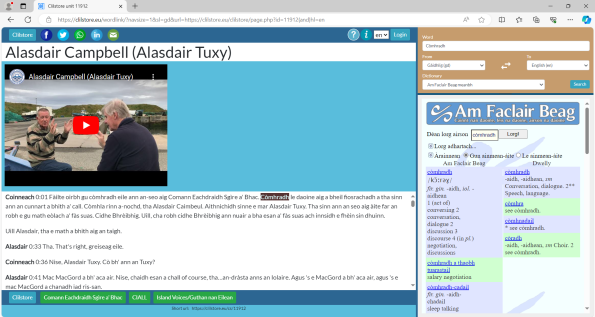
“Fàilte oirbh gu còmhradh eile ann an-seo aig Comann Eachdraidh Sgìre a’ Bhac …”

Alasdair Campbell (Alasdair Tuxy) is interviewed by Coinneach MacÌomhair at Breivig Pier.

And with CIALL assistance, another wordlinked transcript has now been created on the Clilstore platform:

https://clilstore.eu/cs/11912

Powered by WPeMatico


Tadhail air Island Voices – Guthan nan Eilean
Taighean-tughaidh playlist

Le Gordon Wells

TommyandBettyTobhtapic

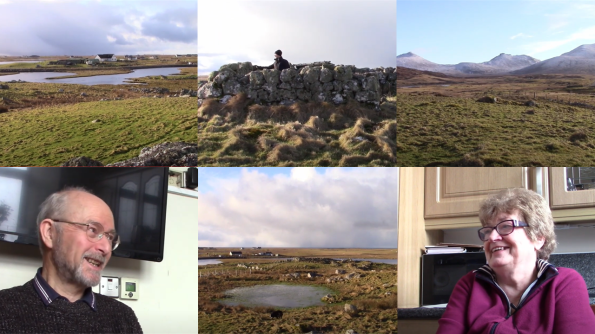
Island Voices has created a new playlist on the YouTube video channel for the collection of recordings made about Uist’s taighean-tughaidh – thatched houses. First contributions have come from Tommy MacDonald, telling some of the history from the site of Tobhta Mhic Eachainn and its connection to the “French Macdonalds”, and then quizzing his wife Betty on her memories of being raised in a taigh-tughaidh.

These recordings have been broken up into bite-sized manageable chunks.

In the first two from Tobhta Mhic Eachainn, Tommy presents some stories about Neil MacEachan and his son Alexandre – the “French Macdonalds” – from the remains of Neil’s original house, which was later to be visited by the Duke of Tarentum in an act of filial homecoming following the Napoleonic wars. The video descriptions include links to Clilstore online transcripts for both of these clips, which are also optionally subtitled.

The conversation with Betty comes in four parts. In the first section Betty recalls who built her house (her grandfather), and aspects of her childhood life on the croft, including the herding and milking of the cattle, as well as some of the thatching process as she remembers it.

In the second part Tommy and Betty go on to discuss some of the stiff challenges that would be entailed in keeping a traditional thatched house on a par with modern standards. Talking about the cèilidh culture of earlier times, Tommy recalls how stories would be shared between family members and visitors – some of which remain unexplained to this day.

In the third section Betty and Tommy’s attention turns towards food and drink, and the important place of staples such as eggs and milk – and sometimes rabbit. Services such as electricity and water were a relatively recent introduction. They recall some of the other thatched houses in the area, with a handful having been done up to meet modern standards.

Finally, in the fourth part, Tommy and Betty share memories of more recent times, when a thatched house was converted into a hostel for tourists, under Betty’s mother’s care. In the early days visitors would often stay for weeks, helping out on the croft, and they are fondly remembered. To end, more stories are shared of amusing and perplexing incidents.

Again, Clilstore links are available in the video descriptions, with auto-translatable subtitles an additional option for learners or non-speakers of Gaelic.

The seventh video in the playlist is a longer “omnibus” edition of the Tommy and Betty conversation, which is presented without transcript or subtitles.

With Tommy planning further recordings in the community we can expect more additions to this work in progress in coming weeks, with ongoing CIALL support and in collaboration with the UHI archaeologists based at Cnoc Soilleir.

Powered by WPeMatico


Tadhail air Island Voices – Guthan nan Eilean
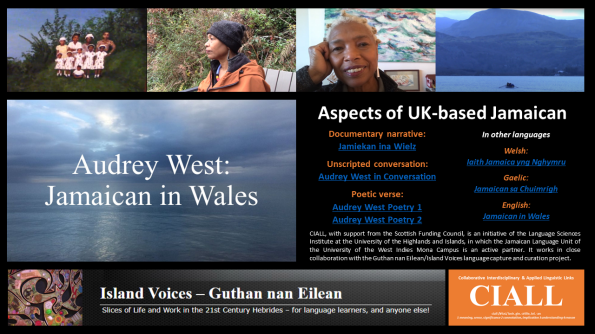
Jamiekan ina Wielz

Le Gordon Wells

Jamiekan yuus puoster pikcha lanskiep faainalSelect any video clip named in this landscape poster, or use the phone-friendly portrait layout.

Island Voices is extending its “language capture and curation” model, with CIALL support, to new contexts, new genres, and new languages, including the recording of aspects of UK-based Jamaican language use. Gaelic enthusiasts can rest assured this development does not represent a move away from our key linguistic interest in the Outer Hebrides! Far from it, as we engage with other language communities near and far, new opportunities are created for fresh spoken material in video format in Gaelic (and English – and other languages).

We recently filmed Jamaica-born, but London-raised, artist and poet Audrey West at her home in Wales. (Keen followers may well recognise Audrey from her previous contribution to our “Talking Points with Norman Maclean” debates.) We have now created Island Voices-style short video clips in the familiar “documentary” and “interview” formats, while adding a third category of “recitation”, newly added to capture Audrey’s poetry. These films are all listed in the poster above. You can click for either landscape or portrait versions to access live links to any and all of the videos created,

We’re also indebted to Dr Joseph Farquharson from the University of the West Indies Jamaican Language Unit (another Talking Points contributor!), for overseeing the creation of the documentary script in the institutionally approved Cassidy-JLU orthography. Joseph and the JLU team have been extremely busy recently, also providing expert advice to Kingsley Ben-Adir and other cast and production team members for the Bob Marley: One Love biopic. As one commenter(!) put it, this YouTube discussion provides “really interesting insights into how skilled linguistic, particularly phonetic, analysis and description can percolate beyond academia and deliver practical applied impact. Bravo JLU!”

This system has enabled regularised subtitling of the clip on sound linguistic principles. Ironically, as YouTube/Google Translate does not recognise Jamaican as a language, we have paradoxically been forced to label the language used in the Jamaican documentary as “English” in order to be able to add the proper Cassidy-JLU subtitles which underline its separate status! We can confidently predict that the YouTube auto-translate function, which we normally commend, is going to struggle with this!

Our aim in due course, will be to also create a Clilstore transcript incorporating the new Custom Dictionary tool, along similar lines to previous contributions from the Jamaican Language Unit.

We have been demonstrating for some time through “Other Tongues” that the re-purposing in different languages of documentary work in our local community context can be accomplished relatively easily and simply. And we most recently illustrated this at scale with the Children’s Parliament in Barra film. The wider point is that this can be a 2-way street, or perhaps a multi-lane spaghetti junction! With Audrey’s documentary we’ve started with a film made originally in Jamaican and, in a reversal of previous examples, worked up a Gaelic version from it. Not only that, we’ve got Welsh and English versions too!

As hinted in our Duncan Ban MacIntyre piece, “Jamaican in Wales” is just the first of a short series of collections in similar style that explore new fields for Island Voices, including poetic expression, and in “displaced” or “exile” contexts. This is work in progress, with more to come from other island geographies.

Di stuori stil a gwaan. Jos laik Bob Marley se, “Wi faawad in dis jenarieshun chrayomfantli!”

Powered by WPeMatico


Tadhail air Island Voices – Guthan nan Eilean

CEUT Reflections

Le Gordon Wells

Here at Island Voices/Guthan nan Eilean we’re delighted to host a first blogpost from Mary Morrison, the co-ordinator and guiding light at Comann Eachdraidh Uibhist a Tuath (CEUT) for the “Aire air Sunnd” wellbeing project, supported by the Ideas Fund. And we look forward to further contributions!

IMG_0190

Picture: Intergenerational walkers and talkers exploring Gaelic heritage between Barpa Langais and Pobul Fhinn as part of the Aire air Sunnd “Fèis Shamhraidh” (summer festival)

Mary writes:

My first post – latha math a h-uile duine!

This is the first attempt at a blogpost – a way of trying to convey what’s happening in our ‘Aire air Sunnd’ project, (Attention to Cheerfulness), from the CEUT co-ordinating perspective. Over the past eighteen months I have been trying to make sense of some ideas that have been buzzing at the edges of my mind, and coming very gradually to understand the areas we need to discuss where we as a project might go next; (I think it was poet Marianne Moore who said, ‘Thought collects in pools’).

We are hoping that North Uist friends and relations will join in these ‘citizen science’ conversations and help push our community’s (or communities’) ideas further. Particularly we need to work out how the project findings can help, first practically, in raising funding to refurbish Sgoil Chàirinis, and second, in gathering evidence convincing enough to make our voices challenge and reverberate at local and national public policy levels.

During a recent recorded forum between Comann Eachdraidh Uibhist a Tuath and our three university research partners, Iain Campbell from the Language Sciences Institute, University of the Highlands and Islands, asked three provocative questions, which I paraphrase as  ‘how do you define a single community, how could such a community be said to be representative and how could it develop agency, make its voice heard in places of power, to make a difference?

Suddenly Iain had provided a scaffold for my scattered reflections – thank you, Iain.

Our small CEUT wellbeing group, facilitated by Jess Wood (working with Heather Morgan of Aberdeen University’s Applied Health Sciences department), met for a series of workshops last year. An open call to CEUT members resulted in ten of us gathering at Sgoil Chàirinis, where we were encouraged by Jess to figure out which aspects of local heritage and wellbeing mattered most to us. We were a mix of long term Gaelic speaking Uisteachs, Uist returners and some who had chosen to settle here and had lived here for over twelve years, with all of us acknowledging the Gaelic language as the pulse or heartbeat of our small, remote island community.

The assimilation of traditional communities is not a simple matter of painlessly extracting one language and culture and transplanting in an inherently superior replacement; the process can induce breaks in generations between families, discontinuities in a community’s sense of place and self- confidence and fractures in a person’s identity….’ (Michael Newton, Warriors of the Word)

What seemed to matter most to our group at its first workshop, in no order of preference, were:

  • Relationships
  • Community
  • Nature
  • Spirituality, (both faith-based and otherwise)
  • Heritage and Culture
  • Learning
  • Stories and Creativity

Working alongside our researchers, we began the process of constructing a survey of our members last winter, to learn more about how these choices can support our communities’ wellbeing, especially after the wearisomely long and anxious period of the pandemic. (CEUT had already recorded aspects of the resilience of different age groups across the island during this period). It was interesting to see and archive, at the end of 2021, how much comfort our community had found in ‘closer family relationships’, the ‘local environment’, and ‘being creative’ as ways of overcoming the isolation and potential loneliness of lockdown.

The main highlights of the Aire air Sunnd survey findings were:

  • the striking importance of community in island life – a major asset
  • concern that North Uist was not being consulted or heard locally or nationally
  • concern relating to the rapid decline in awareness of the distinctiveness of North Uist’s heritage, culture and, in particular, Gaelic language
  • concern about the environment, coastal erosion, loss of biodiversity
  • the commitment of the local community to developing Sgoil Chàirinis
  • support for Gaelic, heritage and wellbeing activities and events in the school
  • support for Gaelic classes and activities that support natural and cultural heritage
  • the use of digital technology for heritage and culture preservation and transmission, with the caveat that individual support with accessing digital technology is a clear need.

Perhaps the time has come now for CEUT:

  • to make use of these findings to recognise our assets and build on these for ourselves? Take more control of this project, so we can spend the remaining months teasing out ‘how’ and ‘why’ these priorities matter so much, learning alongside our research partners how to translate these into compelling arguments?
  • to work out how we can develop confidence in our own sense of agency – what changes can the project evidence achieve for CEUT – how remote is our heritage, (its unique environment, language, culture of resilience) to the dominant discussions in the seats of power?
  • to present our findings in such a way that our welcoming and inclusive Gaelic heritage, and the crucial part this plays in the island’s wellbeing will be better promoted and recognised at local and national levels.

The recently revived Horizon programme, (previously denied to British citizens post-Brexit, but still a major plank supporting the EU’s academic programmes), defines co-creation as ‘a guarantee of the growth of citizen science and innovation in providing public services’. In this project we, CEUT, as the instigators and funded body, acknowledge that it has taken us time to recognise our assets, the importance of our local language and traditional cultural knowledge, as we have worked alongside our researchers. It is imperative now to build on these strengths, resisting any attempts to ‘colonise’ us in ways that do not result in mutual benefits to researchers and CEUT alike. CEUT also needs to find routes for our endeavours to connect with and influence public services. Dr Victoria Rawlings, in her co-authored publication, ‘Community -led research: Walking New Paths Together’, even suggests that ‘community -led research produces better quality research, a better, more fulfilling experience for its participants and more reliable research outcomes’.

We need to gather evidence of what works well locally, for whom, in what settings /contexts and how these can best be supported in such parlous times of fiscal, social and planetary challenge.

Please join in this community discussion!  Do add your thoughts, the more random the more inspirational!

Mary Morrison

Comments welcome!

Comments are welcome, here on this blogpost, or perhaps on the CEUT or Island Voices Facebook pages or Twitter feeds if that’s where you see it first. All platforms will be monitored and all contributions valued!


Tadhail air Island Voices – Guthan nan Eilean
Powered by WPeMatico

Digital Fèis Re-run

Le Gordon Wells

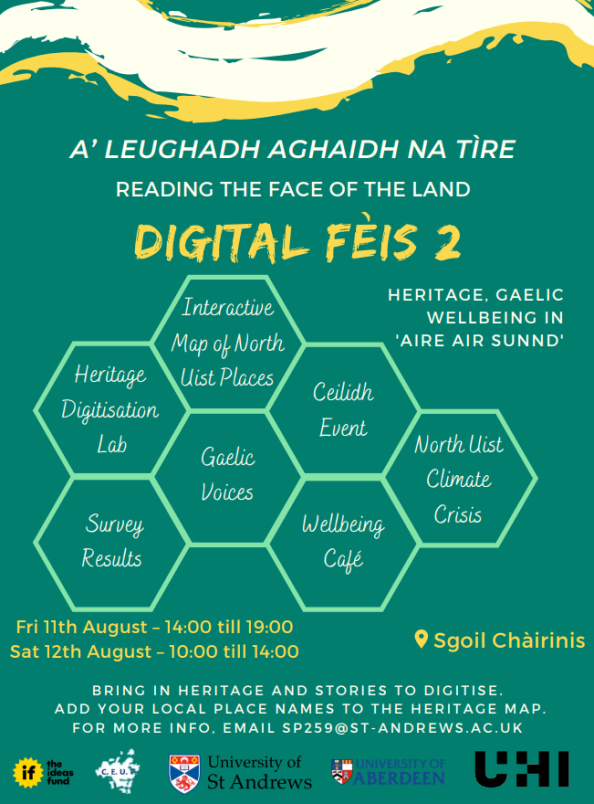
DigFeisPosterThe second Digital Fèis for Aire air Sunnd is now scheduled for 11th and 12th August, taking the place of the May event which had to be postponed. Here’s the updated programme. Island Voices will be represented again, with new video playlists, and there will be additional Gaelic representation from the “Gaelic Crisis” writing team in the interdisciplinary forum on the Friday.

Tadhail air Island Voices – Guthan nan Eilean

Powered by WPeMatico

Climate, Heritage, & Wellbeing Seminar

Le Gordon Wells

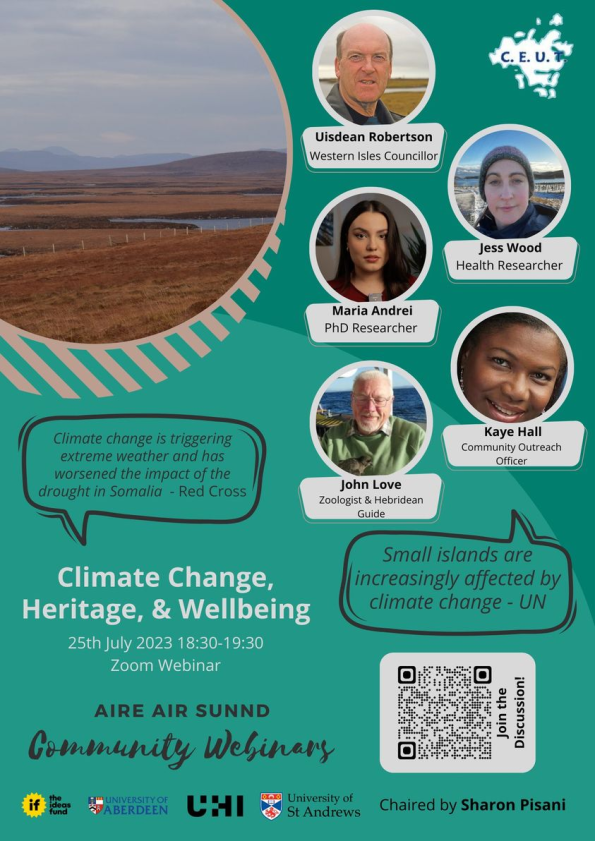
In the second Aire Air Sunnd July webinar a fresh panel discusses “Climate Change, Heritage, and Wellbeing”. This follows on from the previous week’s discussion of the not unrelated topic of Mapping Placenames & Stories of North Uist.

Followers of Island Voices will recall that earlier discussion in the CEUT Gaelic group addressed the theme of coastal erosion in a historical context, with mentions of stories of the last person to walk from Heisgeir to North Uist as well as the no longer evident Baile Siar to the west of today’s Baile Sear. The retention of CEUT chair Uisdean Robertson on the panel from last week provides continuity in this regard, while project officer Sharon Pisani reprises the role of webinar chair.

AASClimateChange

Here’s some of the CEUT description of the webinar from their Facebook page:

“From the shores of North Uist to the tropics of Barbados and the arid landscapes of Somalia, the relentless grip of climate change threatens to erode not only our natural world but also the invaluable heritage that binds us. As rising sea levels and extreme weather events encroach upon our most cherished sites, it is a stark reminder that safeguarding our shared history is intertwined with preserving our planet’s delicate equilibrium….
Book your ticket on Eventbrite to receive the Zoom link:
Don’t miss out on this opportunity to discuss North Uist’s heritage and climate effects.”

Tadhail air Island Voices – Guthan nan Eilean

Powered by WPeMatico

Aire air Sunnd: Digital Support

Le Gordon Wells

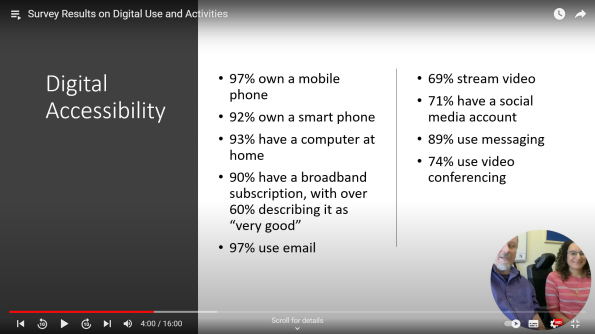
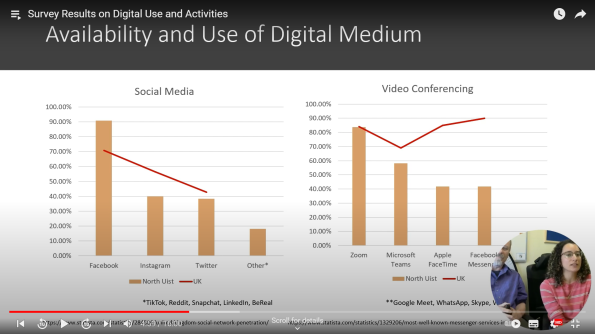
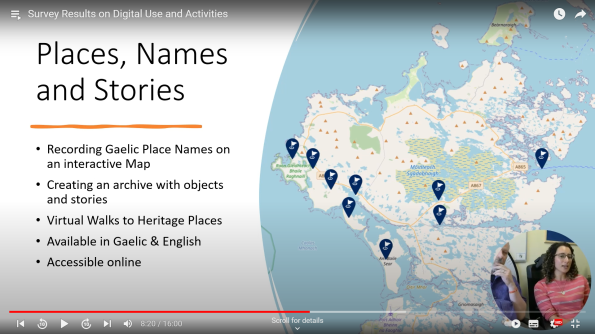
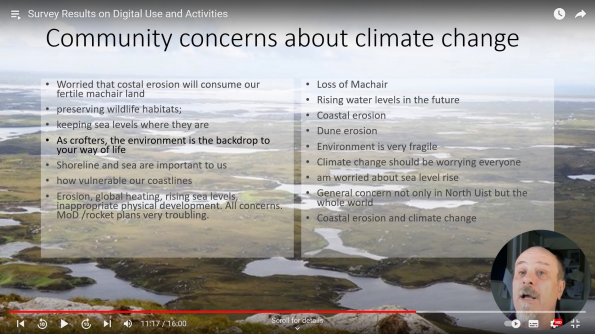
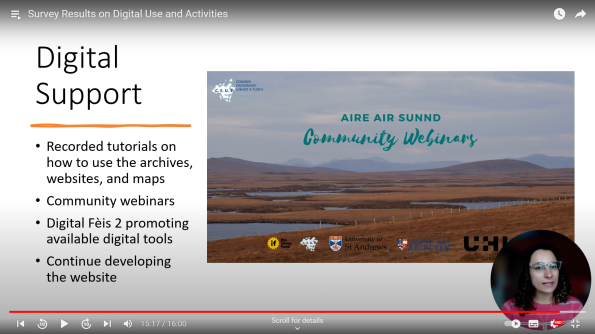
This week the St Andrews team of Alan Miller and Sharon Pisani completed the round-up and review of the Aire air Sunnd survey and activities, following on from Jess Wood and Gordon Wells. Their specific focus was on “Digital use and activities”, presented online again and available to view on YouTube.

These YouTube screenshots will give a quick impression of the range of topics covered: from digital accessibility in the North Uist community, through use of social media, special areas of interest such as Gaelic place names and climate change issues, and on to forthcoming events and ongoing needs – including further guidance on digital opportunities and potential.

Digital Access

Social Media

Placenames etc

community concerns

Digital support

The screenshots give a taste. The “full meal” is available here:

That’s the fourth video in the series of reports – all gathered together on this CEUT YouTube playlist:


Tadhail air Island Voices – Guthan nan Eilean

Powered by WPeMatico

Recording Community Conversations

Le Gordon Wells

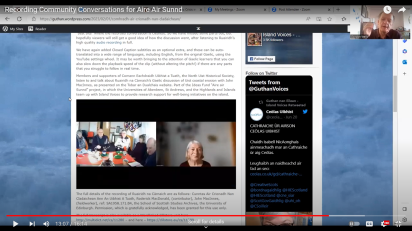
AASReviewImageFollowing on from the North Uist “Wellbeing” survey, Gordon Wells this week reviewed the Island Voices contribution to the Aire air Sunnd project led by Comann Eachdraidh Uibhist a Tuath.

Adopting a slightly different format to Jess Wood’s presentations last week, Gordon speaks to camera on Zoom while screen-sharing key points from the Island Voices Aire air Sunnd webpage. Speaking in Gaelic he reinforces the point that using this language does not exclude non-speakers or early learners, given the multilingual technical resources that are now available online.

His video recaps the various recordings that have been created for the project in the past year or so, including the “Gaelic Crisis” presentation, and the Progress Report, as well as the recording sessions with community members covering storytelling, artefact description, and environmental issues. In so doing, it also shows how the YouTube subtitling and auto-translation functions can be put to effective use, and includes a quick demonstration of the Clilstore platform too, while emphasising the alternative effectiveness of recorded speech in a world where written communication is often taken for granted as the default norm.

Summing up, Gordon stresses the untapped value of various recording collections (in addition to Island Voices’ own), noting in particular how open resources such as Tobar an Dualchais have the potential to bring present and past communities together in a new manner to support North Uist cultural wellbeing, offering innovative ways of forward-looking engagement with the island’s Gaelic heritage so positively valued by all. At the same time, it needs to be recognised that community-wide engagement in such activity is dependent on community-wide comfort with the new digital tools that enable it. This is probably an area of work that needs closer attention.

Here’s Gordon’s talk on YouTube:

You can get a wordlinked transcript, with the video embedded, in this Clilstore unit: https://clilstore.eu/cs/11436


Tadhail air Island Voices – Guthan nan Eilean

Powered by WPeMatico

Wellbeing – and the place of Gaelic

Le Gordon Wells

The results of the Aire Air Sunnd community survey in North Uist are going online. Jess Wood from the University of Aberdeen kicked off on Monday 19th June with an overview, split between two videos on a dedicated CEUT YouTube playlist, both of which are well worth watching to get a sense of the breadth and depth of the project. It’s been an ambitious collaborative exercise, turning out interesting and challenging findings for anyone interested in taking a rooted and holistic approach to community wellbeing across the board.

For those with a particular interest in Gaelic, Jess has devoted quite a bit of time in the first video to analysis of responses on this topic. We’ve picked out some headlines below.

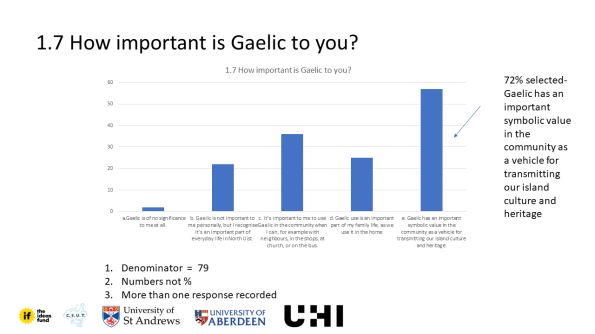
The overall sample of 79 respondents divided themselves up roughly equally between Fluent Speakers, Learners, and Non-speakers of Gaelic.

The slide below shows a really strong level of agreement in the group overall with the notion that “Gaelic has an important symbolic value in the community as a vehicle for transmitting our island culture and heritage”.

Aire Air Sunnd, Wellbeing survey methods results_15. 06.23_part 1_finalHowImportant

Another immediately striking statistic is the 90% figure for those expressing concern over the declining trend in use of Gaelic, as shown in this slide:

Aire Air Sunnd, Wellbeing survey methods results_15. 06.23_part 1_finalninetyOverallconcern

And what may be particularly interesting about this figure is the way that similar sentiment is shared across all three groups – Fluent Speakers, Learners, and Non-speakers – with even 58% of those who have no Gaelic expressing concern about the decline in its use.

While Jess is duly cautious in her presentation, a topic eliciting a 90% level of concern might well be considered a community wellbeing issue worthy of further investigation…

If these figures pique your interest do take a look at the online presentation to find out more. The project also plans to run another face-to-face event in August at which Gaelic and other questions arising from the survey will be further discussed and developed. You can find full details and keep abreast of other events leading up to it on the CEUT Facebook page.

Here’s Part 1 of Jess’s presentation, in which she provides an update on the findings of Section 1 of the survey (including the questions on Gaelic):

In Part 2, Jess talks about the key findings of Section 2 – Use of the School, and Section 3 – Personal Wellbeing:

And coming soon, keep an eye out for an Island Voices video follow-up from Gordon Wells on “Recording Community Conversations”, to be followed shortly after by more detail on Digital Use and Activities with Alan Miller and Sharon Pisani from St Andrews University.


Tadhail air Island Voices – Guthan nan Eilean

Powered by WPeMatico