Le Gordon Wells

Now successfully launched, the online UHI Island Voices Multilingual Archive is officially live, with free and open access for all!
Powered by WPeMatico
Tadhail air Island Voices – Guthan nan Eilean
Trusaiche blogaichean

Le Gordon Wells
Now successfully launched, the online UHI Island Voices Multilingual Archive is officially live, with free and open access for all!
Powered by WPeMatico
Tadhail air Island Voices – Guthan nan Eilean
Le Gordon Wells
Here’s the fourth of our series of blogposts by Mary Morrison in which she reflects on the Aire Air Sunnd project led by Comann Eachdraidh Uibhist a Tuath. As with her previous posts, comments are welcome!
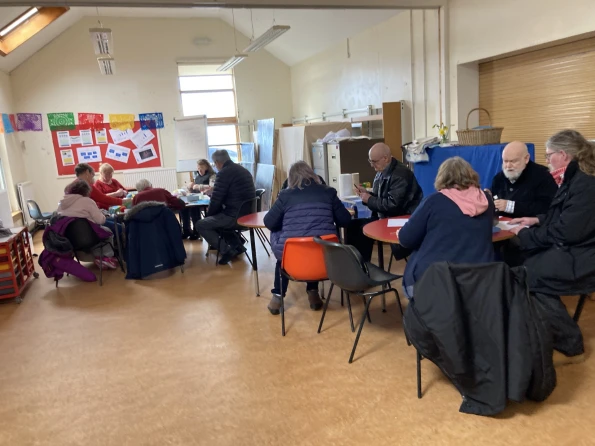
Cafaidh Gàidhlig agus Feasgar Dimàirt.
‘Even the sheep and cows seemed to know who we were.’
During February and March the wellbeing and Gaelic groups have spent an interesting time sharing our thoughts about the place of North Uist, based on the key findings of the CEUT 2023 Community Survey. We have tried to explore further the unspoken, deeper meanings lying beneath our concerns, in order to provide more pressing evidence to convince potential funders of the urgency of our bids for the refurbishment of Sgoil Chàirinis, as a Gaelic, heritage and wellbeing community centre.
The common concern underlying these activities is our attempt to define CEUT’s role in so far as it may contribute to the local communities’ sense of wholeness, robustness and cheerfulness. The project wants to encourage some form of cultural shift, using the aspects of our place that are our greatest assets to fortify the island’s biological, environmental and human wellbeing. The wisdom inherent in vernacular voices and local practices may be best suited to reach the centres of power and exert some influence?
The ideas developed during Feasgar Dimàirt will also be incorporated into a community mural, (or separate panels of such a wall hanging) to celebrate the unique heritage and resilient Gaelic culture of North Uist – a collaborative visual legacy for the project, and a way of combining a wide range of the communities’ artistic and storytelling talents. We are grateful to our partners here, Caraidean Uibhist and Sgoil Uibhist A Tuath for collaborating so willingly in this placemaking effort.
To begin the process of mural shaping we discussed what made us most happy about living on North Uist. The listening was intent, the group itself seemed at home, offering respect, calmness and space to put complex ideas and feelings into words, at our own pace, often qualifying and refining these.
Our recurring ideas:
‘Clarity of the light’, ‘changing colours of the water’, ‘layers of colours of the sand the seaweed and the sea as it stretches to infinity’, ‘poetry of creation’, ‘the sound of the sea’, ‘roaring like traffic’, ‘mindfulness’, ‘losing yourself’, ‘birdlife”, ‘walking for ever without a destination’, ‘the capacity of the environment to change so suddenly’, ‘peace and beauty’, ‘a constant surprise’.
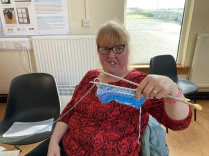 Gaelic method of reciting of the male members of a family tree, sloinneadh, all the precious ‘connections to the local community’, heritage of knitting, peats, creel and rope making, weaving, families widening out but often returning, ‘recognising our closeness to other cultures‘, ‘confidence in new life’, growth – babies of all species- keeping the ceilidh culture and the songs going, the ‘friendliness’ of the community.
‘Views that have remained unchanged from what our ancestors saw’, noticing the changes in coastline, species, disappearance of Gaelic, wells, standing stones and their stories, some urgency to preserve. ‘Getting more sentimental as I grow older’. Mention here of milestones, waymarks trails, mapping the area for future generations and visitors, with the stories attached to them.
‘Last night the tide was very high, I went out and stood, just watching it.
I suddenly felt so glad to be living.’
‘Glad to be here’
‘Coming from a dry, hot and dusty area, the silence, nothing, the sound of the sea was astonishing.
‘Even the sheep and cows seemed to know who we were’
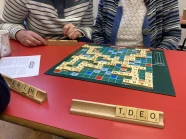 The Cafaidh Gàidhlig sessions were also held in Sgoil Chàirinis over February and March. Smaller numbers here made these more intimate occasions and provided Gaelic speakers with an opportunity to speak freely in an informal setting. Games and learning activities, including the new Gaelic version of Scrabble and a beginners’ Gaelic lesson were available each morning.
Gaelic speakers were able to engage fully in profound conversations without having to give way to English. What was noticeable, to a learner was the ‘comfort’ of the speakers, the remarkable concentration on listening to each other, the lack of interruption, the implicit natural respect in turn taking, the quality of engagement, agreement and reinforcement for each speaker, the rapidity of the flow of cadence and expression, together with the ease and frequent hilarity of the discussion. To a learner, it felt like a privilege to be included so fully within the ‘cosmos’ of the language as it is spoken naturally, something that lessons rarely capture.
Areas discussed included:
There followed a discussion about activities which would promote Gaelic and provide a greater presence for the language in the community.
A discussion followed as to what may be done to ensure that Gaelic has a viable future as a living community language in the face of many challenges. The most pressing being the lack of Gaelic use among the young, for whom English tends to be the default language, even for those attending Gaelic-medium education.
Members of both groups expressed a wish for the two activities to continue and we are hoping these will become monthly CEUT events, keeping up the momentum, closeness and energy the pilot events have inspired. We have recorded the speakers who have led the discussions so far and still have more to record, especially the evening talk on Coastal Erosion with Stuart Angus in the final week in July.
As Michael Newton states in ‘Warriors of the Word’:
‘As the Gaelic sense of place is one in which communal history is embedded in the placenames attached to landscape features, it depends to a great degree upon understanding the language in which the placenames were coined’.
Powered by WPeMatico
Tadhail air Island Voices – Guthan nan Eilean
Le Gordon Wells

Island Voices Co-ordinator Gordon Wells was delighted to be invited to speak to the University of Arizona Celtic Linguistics Group recently (14th October) about Island Voices, with specific reference to Norman Maclean’s notable contribution to the project. Gordon’s presentation is available online, and includes lots of Island Voices screenshots with live embedded links so that anyone interested can explore the site further.
Here’s the abstract for the talk:
“Gordon’s presentation samples and contextualises some of the multi-faceted mainly Gaelic contributions by the multi-talented creative icon, Norman Maclean, to the “Guthan nan Eilean/Island Voices” online language capture and curation project. These include Norman’s final “Saoghal Thormoid” (“Norman’s World”) series of videoed conversations, recorded in April 2016, in which Norman spoke reflectively of his memories and impressions of bilingual life in Glasgow and the Hebrides from the middle of the Twentieth Century onwards. In addition to offering a vivid first-person voiced and experiential account of Gaelic life over a tumultuous period for the language, the Island Voices adherence to basic linguistic principles also pays dividends in relation to some initially unpredicted spin-off applications. These are discussed in conclusion.”
And here’s the recording of the talk on YouTube, including follow-up comments and questions from the group. Many thanks to the Celtic Linguists of Arizona!
And in a new departure for Island Voices, if you can’t find the time to watch the video, there is a Twitter thread which you can follow to get a quick slide-by-slide commentary on the main points. These also link back to the online PDF, and so to all the embedded webpages referenced if you want to dig deeper into the material at any point.
Tadhail air Island Voices – Guthan nan Eilean
Powered by WPeMatico
Le Gordon Wells
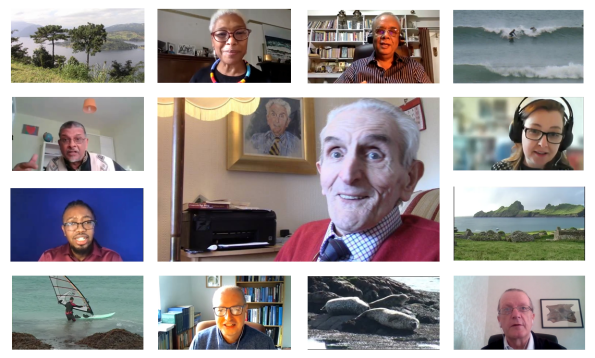 Sna seachdainnean mu dheireadh aig a’ phròiseact Mediating Multilingualism aig Institiùd Rannsachaidh Cànain Oilthigh na Gàidhealtachd ‘s nan Eilean thàinig na com-pàirtichean eadar-nàiseanta sna h-oilthighean ann an Alba, Diaimeuga, agus sna h-Innseachan còmhla airson cuspairean san robh ùidh aca uile a dheasbad cuide ri luchd-labhairt às an Rìoghachd Aonaichte aig a bheil cànanan coimhearsnachd. Chleachd iad pìosan a-mach à Saoghal Thormoid airson na deasbadan (a chaidh a chumail sa Bheurla) a thòiseachadh. Chaidh na còmhraidhean seo a chlàradh, agus tha iad a-nis ri fhaighinn air sianal YouTube Guthan nan Eilean.
Bheir an clàr shìos ceanglaichean ris na deasbadan gu lèir, cuide ris na bhidiothan le Tormod MacGill-Eain a’ bruidhinn.
| Cuspair | Còmhradh Clàraichte | Earrann à Saoghal Thormoid |
| Cànanan ann an Cunnart | Talking Points 1 | Saoghal Thormoid 1 |
| Cànanan air an Rangachadh | Talking Points 2 | Saoghal Thormoid 2 |
| Cànanan Taobh ri Taobh | Talking Points 3 | Saoghal Thormoid 3 |
Faodar criomagan às na h-earrannan ann an Saoghal Thormoid fhaicinn an seo, airson blasad fhaighinn dhe na beachdan aig Tormod fhèin.
| 1. Gaelic Trajectory? | 2. English Ascendancy? |
| 3a. Bilingual Balance? | 3b. Homecoming Postscript |
Agus ma tha ceistean agad, no ma tha thu airson puingean a thogail air-loidhne sna deasbadan seo, faodaidh tu pàirt a ghabhail sna còmhraidhean a bhios a’ dol ann am MOOT Guthan nan Eilean! Rud nach bi a’ tachairt a h-uile latha… Siuthad! Carpe diem!
Tadhail air Island Voices – Guthan nan Eilean
Powered by WPeMatico