
Le Gordon Wells
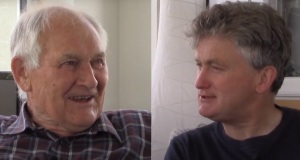 Happy Birthday to Alasdair Crois Mòraig!
Belying Alasdair MacDonald’s youthful looks and demeanour, we’re reliably informed that 14th October 2020 is a particularly special day, marking the completion of his 80th year. We can only wish him many more happy returns!
We mark the day by featuring his own contributions to the Stòras Beò nan Gàidheal collection, in conversation with Archie Campbell. Alasdair has his own inimitable style in rich North Uist Gaelic, and we’re grateful for his daughter Kirsty’s help with one or two words in the transcripts that had left earlier scribes rather scratching their heads…
In the first part, Alasdair talks about his life-time commitment to crofting on North Uist, which his son is now continuing. His first schooling was in Carinish, with his fondest memory being of getting out into the garden, followed by Bayhead, and one year in Inverness, which he didn’t like. On returning to Uist he has worked his croft full-time ever since. He recalls the house-visiting customs of earlier times. His wife, Annie, is from Broughty Ferry, but Alasdair would find it difficult to live somewhere else if it wasn’t by the sea. He’s seen many changes since the time crofters would work with horses, and he explains fertilising and storage practices using seaweed and potatoes.
The wordlinked transcript is available here: http://multidict.net/cs/8245
In the second part, Alasdair remarks on developments since the 60s, such as the advent of tractors for horses, the Baleshare causeway, local government reorganisation, and European Union development funds. He also talks about a visit to New Zealand and the evident Gaelic influence in its recent history. The discussion shifts to discussion of changes in the Uist physical environment. Shipwrecks are also talked about and the cargo they might yield. Alasdair explains the history of the name Crois Mòraig, and talks about the strength of Gaelic in the community, and reflects on the rhythm of the seasons experienced through crofting.
The wordlinked transcript is available here: http://multidict.net/cs/8246
Tadhail air Island Voices – Guthan nan Eilean
Powered by WPeMatico
 We continue our exploration of the North Uist cluster in
  Angus MacPhail from Clachan in North Uist is another well-known member of the community who kindly agreed to contribute to the
  Another two-way conversation in the
 Visitors to the annual
  In amongst the valuable Gaelic social history,

 This final article – a printed version of a text originally written to be read aloud as a presentation to a listening audience, a text therefore first written to be voiced and then later readjusted to be read (silently?) rather than listened to – also reminds us of the third challenge this special issue has highlighted. How can the written form of an article, editorial or book express the ‘what else’ or ‘what different-ness’ of reading aloud? How can words on paper or screen contain that which we are arguing voice adds, ear captures and body enacts? This challenge is made explicit by Wells, but we can also read each of the other pieces with an eye (or ear) for how this struggle plays out.”