Ceangal Caraibianach

Le Gordon Wells

Abair latha inntinneach a bh’ ann air an “Taigh-tasgaidh Digiteach” (Digital Museum) air 21/02/21 – Latha Eadar-nàiseanta nan Cànan Màthaireil. A’ tòiseachadh ann am Bangladesh – far an do rugadh an iomairt airson cànain ar màthairean a chomharrachadh air làtha sònraichte air an son – bha 4 seiseanan eadar-dhealaichte air an cumail fhad ’s a bha a’ ghrian a’ gluasad chun an Iar, le Gàidhlig air a comharrachadh ann an Seisean 3 cuide ri Jamaican.

Jamaican?!? Seadh, agus le deagh adhbhar. Bha na bha aig an neach-teagasg cànain Audrey West ri ràdh mu dheidhinn dì-meas agus dà-chànanas fìor inntinneach, a’ leantail air òraid ghoirid leis an àrd-ollamh Conchúr Ó Giollagáin air Staing na Gàidhlig, agus còmhradh eadar Gordon Wells agus Jibunnessa Abdullah air Guthan nan Eilean. An uair sin bha òran Gàidhlig ann le Meg Hyland – ‘Air Tir an Raoir, air Muir a Nochd’ – a chòrd ris a h-uile duine, air a leantail le beagan deasbad, mus tàinig an tachartas gu crìoch le Yvonne Blake a’ toirt dhuinn “Colonization in Reverse” leis a’ bhàrd ainmeil Louise Bennett Coverley.

Chaidh an seisean air fad a chlàradh air Zoom, agus ‘s urrainnear fhaicinn saor an asgaidh (an dèidh clàradh) tron cheangal seo: https://tinyurl.com/HebrideanCaribbean.

Running order:

Introductions 00.00.00
Conchúr Ó Giollagáin 00.12.50
Gordon Wells 00.31.50
Audrey West 00.50.45
Meg Hyland 01.09.50
Discussion 01.23.20
Yvonne Blake 01.35.35
Conclusions 01.39.45

Thathas an dòchas gun tèid ceanglaichean a bharrachd a thogail eadar “muinntir nan Eilean” agus an cànain air an dà thaobh dhen Chuain sna h-amannan ri teachd!


Tadhail air Island Voices – Guthan nan Eilean

Powered by WPeMatico

Stòras Beò: Magaidh

Le Gordon Wells

Maggie Smith, from Achmore on Lewis, has been doing a power of work collecting and recording Gaelic stories and poetry around and about Lewis for a number of years, many of them curated on her own website, and reproduced on the Island Voices page dedicated to her work. Nor has lockdown stopped her, as she reveals in this conversation with Pàdruig Moireach conducted over Zoom.

This is a new and experimental departure for the Stòras Beò nan Gàidheal team, seeking to make a virtue out of necessity. Indeed, in some ways community recording work may become easier as more and more of us get accustomed to using technology to overcome physical barriers. If this works well, we can expect more of this kind of material in the months to come.

In the first part, Maggie talks about early childhood memories and stories of Glasgow where she was born, though her Achmore roots go back many generations. Returning home she recalls the kind of upbringing island children of her age received, in which community links and mutual responsibilities were strong. Grandparental stories from work experience in Patagonia, and snatches of Spanish at the fank guarded against cultural introversion. She recalls her schooling, and the impact of television’s arrival on cèilidh culture, with traditional work on the land noticeably falling off in the 80s, particularly after oil work began.

A wordlinked transcript, with the video embedded, is available on Clistore here: https://multidict.net/cs/9169

In the second part Maggie and Pàdruig talk about trends in island work patterns over the years. The advent of the Arnish yard led to skills development opportunities for men across Lewis, which many later put to use in openings around the world. Weaving was a traditional occupation, frequently practised in combination with other jobs. Even as a schoolchild Maggie was accustomed to fitting her schoolwork into other duties, such as fetching water for the house. After a short spell working in Inverness after school, she returned to work with the family haulage firm for many years, before branching out into media work, tourism and other projects.

A wordlinked transcript, with the video embedded, is available on Clilstore: https://multidict.net/cs/9170

In the third part Maggie talks more about her cultural activity in the community, including community drama based on locally sourced stories, and the collection of local poetry. Moving to Zoom during lockdown has created a new platform for locals to share stories and for incomers and Gaelic learners to learn about the culture, recreating old communities and gathering new people. She also talks about the power of music and song in working with older people at risk of memory loss, and of collecting fishermen’s stories, mostly in Gaelic. The conversation ends with a discussion of changes that have come over Achmore and the use of Gaelic in the community.

A wordlinked transcript, with the video embedded, is available on Clilstore: https://multidict.net/cs/9171


Tadhail air Island Voices – Guthan nan Eilean

Powered by WPeMatico

Creative Craigard!

Le Gordon Wells


Our Craigard film was the first we ever made, and we keep returning to it for inspiration!

This week’s exciting news, following our posts last Friday and Saturday, is the addition of optional subtitles to the Island Voices Gaelic videos on our YouTube channel. When we asked who would be interested in such a development on our social media last weekend, the positive reactions quickly came back in their hundreds. (Some folk also wanted the reassurance that this would not mean the withdrawal of un-subtitled videos or of the Clilstore transcripts – we have no intention of doing either!)

Given the strongly expressed enthusiasm, the response from the Speech Recognition research project team has been instant and impressive. Systems have been set up to enable the automatic subtitling of all the Gaelic output on our Island Voices Videos YouTube channel, and all 20 films in Series One are already done – with the Craigard documentary in first place on the playlist. Keep an eye out for swift progress on Series Two and other films in due course!

The way in is through the CC “Closed Caption” button. To see any subtitles at all, that needs to be on. (So the default viewing remains clear of any textual additions.) You should now see the Gaelic subtitles.

But that’s not all – once you have them enabled, there’s another clever little trick that enables Google Translate to work on them. If you go into Settings (next to CC) and then click on “subtitles” you’ll find an “auto-translate” option, which then opens a wide range of languages into which the Gaelic subtitles can be translated. (WARNING: if you want English, DON’T go for the “English auto-generated” option first offered. Follow instead the “auto-translate” route and then pick English from the dropdown menu – unless you want a good laugh at “Artificial Intelligence”!)

Machine translation remains an imperfect science, of course, so any expectation of error-free renderings will inevitably be disappointed. Nevertheless, even without this extra facility, Gaelic learners stand to benefit just from using the Gaelic subtitles alone as an extra support for their eyes to help their ears recognise what they’re hearing.

So here’s the Craigard film again – this time with the new multilingual subtitle functionality added.

Nor is this the first time that the Craigard film has taken the lead in test-driving new innovations and community adaptations. Donald Mackinnon’s re-voicing of the original films in Gaelic and English was our first step along the road to the re-purposing of many of our films in Other Tongues. And, much more recently, it’s the film Valentini Litsiou chose for her Greek contribution. (Donald’s versions are actually hosted on a different YouTube channel, so the subtitling option is not available for them – but he did the film in both Gaelic and English, anyway!)

Donald in Gaelic:

Donald in English:

Valentini in Greek:

Who can say what the next innovation will be?


Tadhail air Island Voices – Guthan nan Eilean

Powered by WPeMatico

Flòraidh “ioma-chànanach”!

Le Gordon Wells

Gàidhlig agus Beurla, gu cinnteach – ach a bheil cànain eile aig Flòraidh NicDhòmhnaill? Agus ma tha, cia mheud!?

Abair seachdain “techie” a th’ air a bhith aig Guthan nan Eilean. Bha fèill mhòr Dihaoine is Disathairne sa chaidh air na fo-thiotalan “automataigeach” a chaidh a chruthachadh aig Oilthigh Dhùn Èideann ann am pròiseact Shoillse, ach dè eile a thàinig a-mach à sin ach cothrom fo-thiotalan a chur air na bhidiothan Gàidhlig uile gu lèir a th’ aig Guthan nan Eilean air YouTube! Cha ghabh an obair sin dèanamh taobh-a-staigh latha, ach tha an sgioba ris a’ ghnothach, agus tha Sreath 1 deiseil mar-thà.

Chan e sin deireadh an sgeòil ge-tà. Le fo-thiotalan “san t-siostam” a-nis tha sin a’ fàgail gur urrainnear “eadar-theangachadh” a thabhann cuideachd tro Google Translate air na fo-thiotalan sna bhidiothan. Cha bhi iad gun mhearachd idir, ach can nam biodh càirdean agad aig nach eil Gàidhlig: an dèidh dhut “CC” a chur air, faodar an uair sin na settings air “subtitles” atharrachadh gu “auto-translate” airson tionndadh air choireigin a thabhann dhaibh ann am Beurla – no Frangais, Gearmailtis, agus iomadh cànan eile.

Seo Flòraidh, ma tha, ann an Sreath 1, ri “leughadh” cha mhòr ann an cànan sam bith a thogras tu.

Agus mar chuimhne air a’ chuspair air a bheil i a’ bruidhinn, cuir sùil a-rithis air a’ phost “Community Adaptations” airson tionndaidhean eile (gun fo-thiotalan) fhaicinn dhe na filmichean aithriseach a thòisich an còmhradh, le seann charaid eile aig Guthan nan Eilean na rionnag annta…


Tadhail air Island Voices – Guthan nan Eilean

Powered by WPeMatico

“Oral Literacies”

Le Gordon Wells

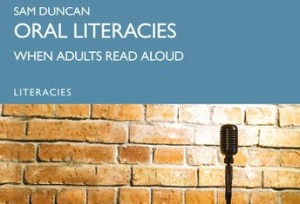
Following her major project on Reading Aloud, in which she included research on Gaelic as well as many other languages in England, Scotland, and Wales, Sam Duncan has now written a book about it. The title, “Oral literacies”, nicely encapsulates the challenge to many established orthodoxies around language and learning that Sam clearly, yet warmly articulates within its pages.

This is, in fact, the second substantial publication emerging from the project, following the special issue of Changing English last year which compiled a number of papers from the UCL symposium on the same topic. These included Gordon Wells’ paper on Island Voices, which focussed on the primacy of speech while freshly acknowledging the porosity of the boundary with written language.

While proponents of established language teaching regimes (and writers of census questions) may still find it appropriate to categorise linguistic behaviour in terms of a traditional “four skills” matrix, it’s refreshing to find research work which interrogates a rigid compartmentalisation of reading, writing, speaking and listening. Approaching, as she does, from a quite different perspective to that of Gaelic revitalisationism, it may nonetheless be significant for those engaged in the latter that “orality” features highly in Sam’s treatment.

And the book’s comprehensive index enables the selective reader to focus in on particular interests, such as Gaelic, psalm-singing, or indeed Island Voices!

Here’s the full back-cover description of the book.

This is the first book to focus exclusively on an examination of early 21st-century adult reading aloud. The dominant contemporary image of reading in much of the world is that of a silent, solitary activity. This book challenges this dominant discourse, acknowledging the diversity of reading practices that adults perform or experience in different communities, languages, contexts and phases of our lives, outlining potential educational implications and next steps for literacy teaching and research.

By documenting and analysing the diversity of oral reading practices that adults take part in (on- and offline), this book explores contemporary reading aloud as hugely varied, often invisible and yet quietly ubiquitous. Duncan discusses questions such as: What, where, how and why do adults read aloud, or listen to others reading? How do couples, families and groups use oral reading as a way of being together? When and why do adults read aloud at work? And why do some people read aloud in languages they may not speak or understand?

This book is key reading for advanced students, researchers and scholars of literacy practices and literacy education within education, applied linguistics and related areas.

There was an online launch at Lancaster University in early January, for which Sam wrote this blogpost:

https://literacieslog.wordpress.com/2021/01/04/oral-literacies-when-adults-read-aloud-launch-of-the-book-by-sam-duncan-on-8th-january/

The scholarship is meticulous throughout the book in its treatment of a fascinatingly wide-ranging and ambitious topic. Nonetheless, Sam’s writing style (of which the blogpost gives us an example) remains clear, approachable, and fundamentally humane – while pleasingly sprinkled with evocative surprises:

“… and in the background we might hear the sounds of Gaelic karaoke…”

The interested readership may well extend beyond the purely academic!


Tadhail air Island Voices – Guthan nan Eilean

Powered by WPeMatico

Stòras Beò: Màiri

Le Gordon Wells

Mary Robertson is another well-known Benbecula resident, here talking to fellow Baoghlach Archie Campbell for the Stòras Beò nan Gàidheal series of recordings capturing natural conversations between fluent Hebridean speakers of Gaelic.

In the first part, Mary talks about her family and her memories of her early schooldays in Torlum. Her father was a gamekeeper for the South Uist estate. Leaving home at 15 to get further training at Duncraig Castle was a shock. She describes the daily routine there. After that she worked in Edinburgh for two years before moving to Fort William to do hotel work, where she found more of an island community.

A wordlinked transcript alongside the embedded video is available here: http://multidict.net/cs/8252

In the second part, Mary describes returning to Benbecula after losing her husband in an industrial accident, and the changes she noticed, particularly with the increased army presence and the work available through public schemes. She found work in the newly opened Sgoil Lìonacleit, where she continued till retirement. She is also involved with various charities and community groups, and her church involvement has entailed trips abroad to various countries. Her Gaelic interest also took her to Canada. She still dances and enjoys walking in various parts of the Highlands.

A wordlinked transcript alongside the embedded video is available here: http://multidict.net/cs/8253


Tadhail air Island Voices – Guthan nan Eilean

Powered by WPeMatico

Skye Meeting

Le Gordon Wells

Fios agus fiosrachadh:


Tadhail air Island Voices – Guthan nan Eilean

Powered by WPeMatico

Island Gaelic Conversations

Le Gordon Wells

Is there more to Gaelic development than a talking point for academic debate or social media clickbait? How can island voices be heard in discussions and decisions about the language they speak? The “Gaelic Crisis” book has stimulated a re-appraisal of the current situation, and makes suggestions for a new way forward.

A series of “GAELIC CONVERSATIONS – CÒMHRAIDHEAN GÀIDHLIG” is proposed around the islands.

“Alasdair Allan MSP is working with the authors of the study from the Soillse research team based at the University of the Highlands and Islands (UHI) and a cross-party group of MSPs and researchers including Kate Forbes MSP, Michael Russell MSP, Donald Cameron MSP, Rhoda Grant MSP, John Finnie MSP and Dr Michael Foxley.

…..

As well as discussions about Gaelic usage in the home and community, the meetings will also gauge opinion on whether such ideas in the report such as a Gaelic community cooperative – Urras na Gàidhlig – could be an appropriate structure to coordinate and drive forward local development actions under the direct control of the Gaelic-speaking community.”

You can register to attend here. Written submissions are also welcomed.


Tadhail air Island Voices – Guthan nan Eilean

Powered by WPeMatico

Stòras Beò: Ailig

Le Gordon Wells

Moving on to Benbecula this month we feature Alec MacPhee from Nunton – Baile nan Cailleach – in our regular spotlight on contributors to Stòras Beò nan Gàidheal. Alec still lives in Nunton, and has three sons (Donald, Angus, and John), eight grandchildren, and one great grandchild. Here he talks to Archie Campbell, also a Benbecula man.

In the first part, Alec recalls his childhood in Nunton, and wartime schooling in Balivanich – Baile a’ Mhanaich – and then Torlum, including pranks in the playground, classroom, or garden, as well as crofting chores at home, and later with the peats. Leaving school at 14, he started his first paid job in the building trade at 16. He also recalls wartime memories of many different nationalities associated with the airport and POWs, including Australians, Poles, Germans and Italians. He talks too of the end-of-war celebrations and memories of the “Whisky Galore” SS Politician. He then spent some time in Glasgow.

A wordlinked transcript is available here: http://multidict.net/cs/8243

In the second part, Alec relates how he came back to the croft and then got work with a services company which took him and several friends out to St Kilda. He later got work with the Water Board, with whom he stayed until retirement. He also talks about recreational activities, including badminton and football, as well as dances and New Year customs and associated drinking practices. He describes how he met his wife, Margaret, and the details of their wedding, and tells a story of a commando who turned up in the Steadings. Discussion of army-community relations leads to reflection on the changes he’s seen in island life.

A wordlinked transcript is available here: http://multidict.net/cs/8244


Tadhail air Island Voices – Guthan nan Eilean

Powered by WPeMatico

“Living off the edge”

Le Gordon Wells

Conchúr Ó Giollagáin gave this talk online, and the recording is now available on YouTube. His title was “Living off the edge: The crisis in late modern ethnolinguistic diversity from the Gaelic perspective”, and the talk drew substantially from the findings of the recent publication “The Gaelic Crisis in the Vernacular Community”. This is a substantial report on the findings of Soillse’s very comprehensive Islands Gaelic Research Project. It’s a challenging read in many ways, with particular relevance for anyone interested in Gaelic in the Hebrides. From that point of view it’s good to be able to hear Conchúr talk about the research and answer questions about the implications.

He had a lot of ground to cover in 40 minutes. If you missed it live here’s your chance to hear what he had to say – or indeed to listen again in case you feel the need.


Tadhail air Island Voices – Guthan nan Eilean

Powered by WPeMatico