Taisce Bheo: Clíona

Le Gordon Wells

Clíona“Tionscadal píolótach a dhíríonn ar shamplaí cuí eiseamláireacha den chaoi a labhraítear an Ghaeilge agus a’ Ghàidhlig i bpobail Ghaelacha in Albain agus in Éirinn atá sa Taisce Ghaelach. Baintear leas as uirlisí soláimhsithe cláraithe agus teicnící furasta chun an t-ábhar a chruinniú.”

We start with a quote from the Irish language introduction to the UHI “Stòras Beò nan Gàidheal” project, whose Scottish Gaelic samples we’ve been regularly featuring on these pages. It explains that the project aims to collect exemplary samples of Gaelic speech from vernacular communities in Scotland and Ireland with user-friendly equipment and techniques.

The COVID crisis struck just as the Irish recordings were due to be getting underway, causing an inevitable delay. However, following the recent experimentation with Zoom conversations in Scottish Gaelic, a parallel Irish series has now begun recording, following the same pattern. This conversation between Colm Mac Giolla Easpaig and Clíona Ní Ghallachòir is the first to be placed online. Consider it a foretaste of more delights to come!

Clíona is from Meenaclady and Colm is from Gweedore. Clíona is a twenty-one-year-old student who is currently residing in Galway. In the first part of the interview, she speaks about the student experience during the Covid 19 pandemic. She talks about her hometown and her views on the state of the Irish language in the Gaeltacht. She goes on to talk about her interest in singing and storytelling with some mention of local traditions and customs.

A wordlinked transcript alongside the embedded video is available here: https://multidict.net/cs/9452

In the second part of this interview, Clíona talks about the changes occurring in the Irish language communities and her own work experience with both translation and language planning. She goes on to speak about her childhood memories and other interests she would like to pursue. She then speaks about her involvement in drama both onstage and behind the scenes. She discusses the importance of faith in her local area before finally talking about what she would do if she were to win the lottery.

A wordlinked transcript alongside the embedded video is available here: https://multidict.net/cs/9454

If you follow the Clilstore transcript links for either of these clips you will spot an interesting innovation in comparison with the earlier Scottish series. Dr Gearóid Ó Domagáin of Ulster University, who produced the transcriptions, has gone a step further and provided additional footnotes to mark regional variations on the standard. You’ll find these by clicking on the “annotated version” tab in the Clilstore unit. At this point, Guthan nan Eilean aficionados may well also be thinking back to our “Gaelic Journeys” page, and noting previous links to Ulster University and Donegal. This is not the first time Colm has appeared on this site!


Tadhail air Island Voices – Guthan nan Eilean

Powered by WPeMatico

Titles for the Raiders

Le Gordon Wells

AlecScrnShtRetired policeman Alec MacAulay recounted this story in 2014 of his raider father’s bold exploits on coming back home to Uist from the First World War. Returning soldiers across the islands were in no mood for undue deference to the landowning classes, and were taking crofting matters into their own hands, with strong popular support.

“Làmhachas làidir” was the call of the hour. It was a fascinating account, related on the day to Archie Campbell, and recorded as part of the Comunn Eachdraidh Uibhist a’ Tuath project “An fheadhainn tha làighe sàmhach”.

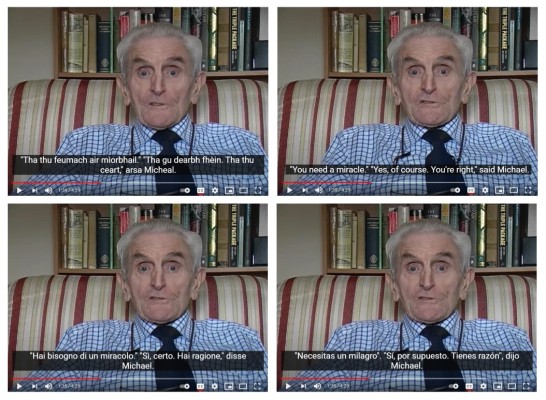
Skilfully told here, it’s a compelling story well worth repeating, and recent techie developments have enabled Island Voices to enhance the access both for learners of Gaelic, and for those who don’t know the language at all. Now you can click on Closed Captions to get written Gaelic subtitles, which can then be machine-translated simultaneously into English and scores of other languages through “auto-translate” on the Settings button. If you missed it first time round, here’s your chance now!

Leading the technical team that’s facilitating this progress for Gaelic is Will Lamb, ex-Colaisde Bheinn na Faoghla, now at the University of Edinburgh. There’s a new report by Lucy Evans on the GARG (Gaelic Algorithmic Research Group) blog, detailing latest developments.


Tadhail air Island Voices – Guthan nan Eilean

Powered by WPeMatico

Techie Tormod

Le Gordon Wells

A couple of Norman Maclean’s impromptu recordings provide the material for trying out the latest developments in Gaelic Automatic Speech Recognition.

NormanMiracles

When Norman kindly offered to record some stories for Island Voices in 2015, he was perhaps already beginning to feel his age. As a result, while he delivered them all with his trademark panache, he opted in the main to read them aloud from pre-prepared scripts. This was a blessing in disguise for Island Voices, as it meant that ready-made transcripts already existed which could be easily transferred to the Clilstore platform, enabling word-by-word clickable translations – all available on our Norman Maclean page.

However, the man was irrepressible, and once he was into his stride he just kept going, meaning a couple more stories were added to the collection off the top of his head. Lively recordings resulted, but without written transcripts – until now. Island Voices has recently been working closely with the Automatic Speech Recognition project in Edinburgh, and a good number of our Gaelic films now offer optional subtitling. These were created by feeding already existing transcripts into the text aligner tool the ASR team developed as part of their work, so that individual subtitles would appear at the right time on the videos. These were texts that had been created by someone sitting down with the recording and manually typing out every word they heard – time-consuming work!

What’s new with these recordings is that it is the ASR tool on which the Edinburgh team are working that has actually itself created the first draft of the transcripts used to produce the subtitles in these films. The results were by no means perfect, and there was still a need for a human ear and hand to tidy them up before they could be used, but it’s a developmental process. And progress is clearly being made, to the extent that the Clilstore gap in our “Sgeulachdan Thormoid” collection has now been compensated for by enabling optional onscreen subtitles on the two extra recordings he made for us – “Mìorbhailteann ann am Barraigh“, and “Bodach nan Serviettes“.

And again, as with earlier versions, once the Gaelic subtitles are in the YouTube system, automatic translation into scores of other languages via Google Translate then becomes instantly available. Norman, among his many other talents, was an enthusiastic linguist – and no slouch with a computer. True, he expressed his reservations about the development of “text talk”, but we can surely allow ourselves to think that this latest technical innovation, with the human voice at its centre (his own!), would have met with his approval.

One for the Barraich:

And the other for the Hearaich:


Tadhail air Island Voices – Guthan nan Eilean

Powered by WPeMatico

Stòras Beò: Anna

Le Gordon Wells

AnnaAnne MacInnes, from Callanish on Lewis, talks to Maggie Smith about her family connections to the Breasclete community and school, where Gaelic Medium Education was pioneered.

In the first section of this two-part conversation Anne reveals how the Callanish Stones have always attracted tourists, but she recalls from her childhood the cèilidh culture amongst the locals, including many “characters”.

Her career to date has been varied, from Gaelic teaching to working at sea, but she remains attached to a crofting lifestyle, still keeping cattle. Currently at home with a baby, she comes from a musical family, and plays box and pipes. With fewer people now working their crofts she’s noticed a change in the appearance of the township.

A wordlinked transcript, with the video embedded, is available on Clistore here: https://multidict.net/cs/9355

In the second part, Anne and Maggie talk about changes in local culture. Noting that change and development are natural, Anne regrets the loss of local distinctiveness in Gaelic speech. The musical culture is strong. The link with the language should be upheld. There have been various sources of employment, including offshore as well as at the hospital or with the council, plus the nearby pharmaceuticals factory and the community-owned visitor centre. Visitors have included royalty. But the community hall offers a local focus. She remembers some of her grandmother’s special words, and reflects on the value of having family relations all around. It’s important to value what’s past, including local songs, as life goes on.

A wordlinked transcript, with the video embedded, is available on Clistore here: https://multidict.net/cs/9356


Tadhail air Island Voices – Guthan nan Eilean

Powered by WPeMatico

Stòras Beò: Calum

Le Gordon Wells

CAF1Calum Alasdair Fraser, from Tolastadh a’ Chaolais, talks to Maggie Smith about his family connections and upbringing on the west side of Lewis.

In his childhood he spent a lot of time outdoors. Though still young himself, he remembers the sound of weaving from many houses – a sound that is no longer heard. After leaving school he tried various jobs in different locations. Now he works on Gaelic issues with An Lanntair in Stornoway.

He talks about how he values the Gaelic language and its close connection to where he lives, even though it wasn’t his home language growing up. He also talks about his musical activities, and his interest in maintaining local interest in Gaelic, relating it to a changed way of life that still has close connections to previous generations.

A full transcript with the video embedded can be viewed on the Clilstore platform here: https://multidict.net/cs/9331


Tadhail air Island Voices – Guthan nan Eilean

Powered by WPeMatico

Guth nan Siarach

Le Gordon Wells

“Guth nan Siarach” (or “Voice of the Westside”) is the name of a new Gaelic community group in Lewis, set up in response to the 2020 publication of the Soillse research book, “The Gaelic Crisis in the Vernacular Community”.

Members of this group recently attended an online Soillse workshop on “New Insights on the Vernacular Gaelic Communities in the Islands”, led by Professor Conchúr Ó Giollagáin. It was a refreshing opportunity for community members to take part in discussion with interested academics from a range of universities, both within the Soillse network and from outwith Scotland.

Some days after the event, Guth nan Siarach members met again on Zoom to record their thoughts, questions, and ideas after hearing Prof Ó Giollagáin’s presentation and taking part in the subsequent discussion. We’re very grateful at Guthan nan Eilean that Jane, Maggie, Christine, Catriona, and Calum were willing to share their thoughts with us.

“Mother tongue” issues are often very close to the heart, and it can take confidence, courage, and no little skill to talk about them openly and with consideration, especially when the language in question has been on the receiving end of prolonged disadvantageous treatment. It’s a privilege to hear the group talk among themselves about issues of concern. We look forward to hearing more in the near future!

We recommend finding the time to watch the full discussion. The contributions are varied, thoughtful, and expressed in good Lewis Gaelic. And thanks to the Gaelic Speech Recognition research team, we’ve added CC Gaelic subtitling, which you can turn on or off as you please – and which will also enable Google translation into other languages:

But if your time is short, you can get a taste of the meeting from these “criomagan”. (CC subtitling also available on this clip.)

And here’s Prof Ó Giollagáin’s presentation:


Tadhail air Island Voices – Guthan nan Eilean

Powered by WPeMatico

Google learns Gaelic

Le Gordon Wells

Five years ago Island Voices posted about “Google Gaelic“, in wake of the excitement over the recent addition of Scottish Gaelic to the list of languages supported by Google Translate. The move, while welcomed in some quarters, was not an uncontroversial one, with many people voicing fears over how it could be easily misused, for example to the detriment of people working in translation services.

The pitfalls inherent in using Google Translate, in particular to try to generate well-formed Gaelic from English input, are still very much there. However, here’s a good news story relating to translation from Gaelic into English. Our five-year old post gave a sample of English text generated by processing the Gaelic voiceover script for our peatcutting documentary through Google Translate. Five years later we’ve just done the same thing again.

You can compare the two texts here, with 2016 in the left column, and 2021 in the right. The later one is still by no means perfect, but it’s still clearly an improvement on the first version. Google is “learning”, and Island Voices welcomes that, particularly in light of the recent adoption of optional CC subtitles on our Series 1 and Series 2 films, meaning the original Gaelic can be machine translated into scores of other languages at the click of a mouse…


Tadhail air Island Voices – Guthan nan Eilean

Powered by WPeMatico

Ceangal Caraibianach

Le Gordon Wells

Abair latha inntinneach a bh’ ann air an “Taigh-tasgaidh Digiteach” (Digital Museum) air 21/02/21 – Latha Eadar-nàiseanta nan Cànan Màthaireil. A’ tòiseachadh ann am Bangladesh – far an do rugadh an iomairt airson cànain ar màthairean a chomharrachadh air làtha sònraichte air an son – bha 4 seiseanan eadar-dhealaichte air an cumail fhad ’s a bha a’ ghrian a’ gluasad chun an Iar, le Gàidhlig air a comharrachadh ann an Seisean 3 cuide ri Jamaican.

Jamaican?!? Seadh, agus le deagh adhbhar. Bha na bha aig an neach-teagasg cànain Audrey West ri ràdh mu dheidhinn dì-meas agus dà-chànanas fìor inntinneach, a’ leantail air òraid ghoirid leis an àrd-ollamh Conchúr Ó Giollagáin air Staing na Gàidhlig, agus còmhradh eadar Gordon Wells agus Jibunnessa Abdullah air Guthan nan Eilean. An uair sin bha òran Gàidhlig ann le Meg Hyland – ‘Air Tir an Raoir, air Muir a Nochd’ – a chòrd ris a h-uile duine, air a leantail le beagan deasbad, mus tàinig an tachartas gu crìoch le Yvonne Blake a’ toirt dhuinn “Colonization in Reverse” leis a’ bhàrd ainmeil Louise Bennett Coverley.

Chaidh an seisean air fad a chlàradh air Zoom, agus ‘s urrainnear fhaicinn saor an asgaidh (an dèidh clàradh) tron cheangal seo: https://tinyurl.com/HebrideanCaribbean.

Running order:

Introductions 00.00.00
Conchúr Ó Giollagáin 00.12.50
Gordon Wells 00.31.50
Audrey West 00.50.45
Meg Hyland 01.09.50
Discussion 01.23.20
Yvonne Blake 01.35.35
Conclusions 01.39.45

Thathas an dòchas gun tèid ceanglaichean a bharrachd a thogail eadar “muinntir nan Eilean” agus an cànain air an dà thaobh dhen Chuain sna h-amannan ri teachd!


Tadhail air Island Voices – Guthan nan Eilean

Powered by WPeMatico

Stòras Beò: Magaidh

Le Gordon Wells

Maggie Smith, from Achmore on Lewis, has been doing a power of work collecting and recording Gaelic stories and poetry around and about Lewis for a number of years, many of them curated on her own website, and reproduced on the Island Voices page dedicated to her work. Nor has lockdown stopped her, as she reveals in this conversation with Pàdruig Moireach conducted over Zoom.

This is a new and experimental departure for the Stòras Beò nan Gàidheal team, seeking to make a virtue out of necessity. Indeed, in some ways community recording work may become easier as more and more of us get accustomed to using technology to overcome physical barriers. If this works well, we can expect more of this kind of material in the months to come.

In the first part, Maggie talks about early childhood memories and stories of Glasgow where she was born, though her Achmore roots go back many generations. Returning home she recalls the kind of upbringing island children of her age received, in which community links and mutual responsibilities were strong. Grandparental stories from work experience in Patagonia, and snatches of Spanish at the fank guarded against cultural introversion. She recalls her schooling, and the impact of television’s arrival on cèilidh culture, with traditional work on the land noticeably falling off in the 80s, particularly after oil work began.

A wordlinked transcript, with the video embedded, is available on Clistore here: https://multidict.net/cs/9169

In the second part Maggie and Pàdruig talk about trends in island work patterns over the years. The advent of the Arnish yard led to skills development opportunities for men across Lewis, which many later put to use in openings around the world. Weaving was a traditional occupation, frequently practised in combination with other jobs. Even as a schoolchild Maggie was accustomed to fitting her schoolwork into other duties, such as fetching water for the house. After a short spell working in Inverness after school, she returned to work with the family haulage firm for many years, before branching out into media work, tourism and other projects.

A wordlinked transcript, with the video embedded, is available on Clilstore: https://multidict.net/cs/9170

In the third part Maggie talks more about her cultural activity in the community, including community drama based on locally sourced stories, and the collection of local poetry. Moving to Zoom during lockdown has created a new platform for locals to share stories and for incomers and Gaelic learners to learn about the culture, recreating old communities and gathering new people. She also talks about the power of music and song in working with older people at risk of memory loss, and of collecting fishermen’s stories, mostly in Gaelic. The conversation ends with a discussion of changes that have come over Achmore and the use of Gaelic in the community.

A wordlinked transcript, with the video embedded, is available on Clilstore: https://multidict.net/cs/9171


Tadhail air Island Voices – Guthan nan Eilean

Powered by WPeMatico

Creative Craigard!

Le Gordon Wells


Our Craigard film was the first we ever made, and we keep returning to it for inspiration!

This week’s exciting news, following our posts last Friday and Saturday, is the addition of optional subtitles to the Island Voices Gaelic videos on our YouTube channel. When we asked who would be interested in such a development on our social media last weekend, the positive reactions quickly came back in their hundreds. (Some folk also wanted the reassurance that this would not mean the withdrawal of un-subtitled videos or of the Clilstore transcripts – we have no intention of doing either!)

Given the strongly expressed enthusiasm, the response from the Speech Recognition research project team has been instant and impressive. Systems have been set up to enable the automatic subtitling of all the Gaelic output on our Island Voices Videos YouTube channel, and all 20 films in Series One are already done – with the Craigard documentary in first place on the playlist. Keep an eye out for swift progress on Series Two and other films in due course!

The way in is through the CC “Closed Caption” button. To see any subtitles at all, that needs to be on. (So the default viewing remains clear of any textual additions.) You should now see the Gaelic subtitles.

But that’s not all – once you have them enabled, there’s another clever little trick that enables Google Translate to work on them. If you go into Settings (next to CC) and then click on “subtitles” you’ll find an “auto-translate” option, which then opens a wide range of languages into which the Gaelic subtitles can be translated. (WARNING: if you want English, DON’T go for the “English auto-generated” option first offered. Follow instead the “auto-translate” route and then pick English from the dropdown menu – unless you want a good laugh at “Artificial Intelligence”!)

Machine translation remains an imperfect science, of course, so any expectation of error-free renderings will inevitably be disappointed. Nevertheless, even without this extra facility, Gaelic learners stand to benefit just from using the Gaelic subtitles alone as an extra support for their eyes to help their ears recognise what they’re hearing.

So here’s the Craigard film again – this time with the new multilingual subtitle functionality added.

Nor is this the first time that the Craigard film has taken the lead in test-driving new innovations and community adaptations. Donald Mackinnon’s re-voicing of the original films in Gaelic and English was our first step along the road to the re-purposing of many of our films in Other Tongues. And, much more recently, it’s the film Valentini Litsiou chose for her Greek contribution. (Donald’s versions are actually hosted on a different YouTube channel, so the subtitling option is not available for them – but he did the film in both Gaelic and English, anyway!)

Donald in Gaelic:

Donald in English:

Valentini in Greek:

Who can say what the next innovation will be?


Tadhail air Island Voices – Guthan nan Eilean

Powered by WPeMatico